
Excavation and Trenching Safety Guide: Soil Classification, Sloping, Shoring, and OSHA Requirements | Projul
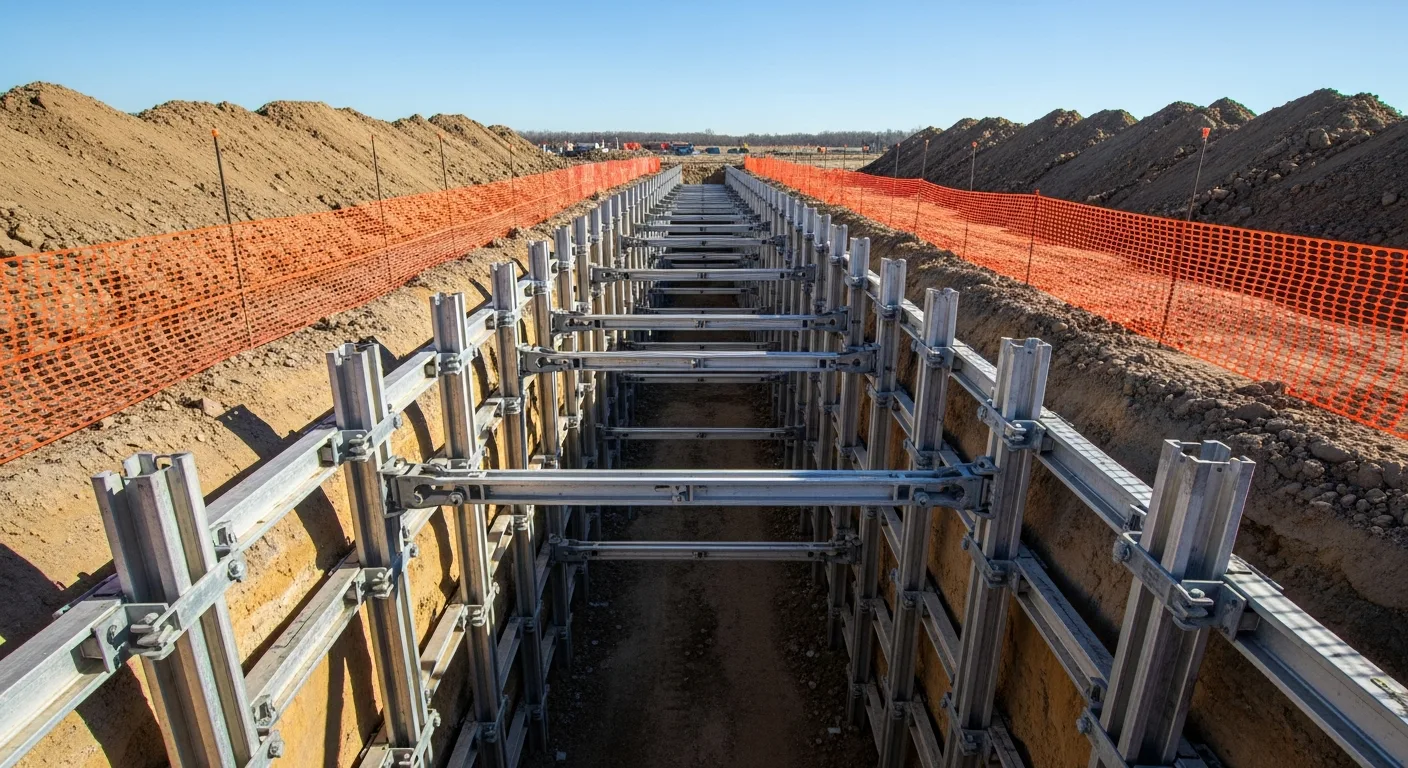
Every year, trench cave-ins kill dozens of construction workers across the United States. Most of these deaths are preventable. The soil gives way, the walls collapse, and a worker who was standing in a four-foot-deep utility trench never makes it home.
If you run excavation crews or manage projects that involve any kind of digging, you need to understand the rules. Not just because OSHA will fine you, but because your people depend on it.
This guide covers everything you need to know about excavation and trenching safety: soil classification, protective systems, OSHA standards, and the practical steps that keep your crew alive.
Why Trenching Is So Dangerous
A cubic yard of soil weighs between 2,700 and 3,000 pounds. When a trench wall collapses, the force is sudden and overwhelming. Workers buried under even a few feet of soil can suffocate in minutes.
Trenching ranks among the most hazardous operations in construction. According to OSHA, the fatality rate for excavation work is 112% higher than the general construction industry average. That number is not acceptable, and it is entirely preventable with the right planning and protective systems.
The dangers include:
- Cave-ins caused by unstable soil, vibration, or water infiltration
- Struck-by hazards from falling tools, materials, or spoil
- Hazardous atmospheres in deep trenches or near utility lines
- Water accumulation that weakens soil walls and creates drowning risk
- Utility strikes that cause electrocution, gas leaks, or explosions
Understanding OSHA’s Excavation Standard (29 CFR 1926 Subpart P)
OSHA’s excavation standard is the rulebook for every trench and excavation on a construction site. Subpart P applies to all open excavations made in the earth’s surface, including trenches.
Here are the key requirements:
Protective Systems Required at 5 Feet
Any trench 5 feet deep or more requires a protective system unless the excavation is made entirely in stable rock. At 20 feet or deeper, a registered professional engineer must design the system.
Competent Person On-Site
A competent person must be present at all times when workers are in or near a trench. This person must be trained to identify existing and predictable hazards, classify soil, inspect protective systems, and take immediate corrective action.
Access and Egress
Workers must have a way in and out of trenches 4 feet or deeper. Ladders, stairways, or ramps must be placed so that no worker has to travel more than 25 feet laterally to reach one.
Spoil Piles
Excavated material (spoil) must be kept at least 2 feet from the edge of the trench. This prevents the weight of the spoil from contributing to a cave-in and keeps loose material from falling on workers below.
Utility Location
Before you dig, you must contact the local utility notification center (811 in most states) to identify and mark underground utilities. This is both an OSHA requirement and state law in every state.
Soil Classification: The Foundation of Every Safety Decision
Every protective system decision starts with soil classification. The type of soil you are digging in determines the slope angles, shoring requirements, and shielding specs for the job.
OSHA recognizes four soil categories:
Stable Rock
Natural solid mineral matter that can be excavated with vertical sides and remain intact while exposed. True stable rock is rare in most trenching situations, but when you have it, no additional protective systems are needed.
Type A Soil
The most cohesive soil type. Type A includes clay, silty clay, sandy clay, and clay loam with an unconfined compressive strength of 1.5 tons per square foot (tsf) or greater. Type A soil can stand with steeper cut angles and requires less support than weaker soils.
However, soil cannot be classified as Type A if:
- It has been previously disturbed
- It is subject to vibration from heavy traffic, pile driving, or similar sources
- It has been fissured
- It is part of a layered system where weaker layers could cause instability
Type B Soil
A moderately cohesive soil with an unconfined compressive strength between 0.5 and 1.5 tsf. Type B includes angular gravel, silt, silt loam, previously disturbed Type A soils, and soils that are fissured or subject to vibration.
Type C Soil
The weakest and most dangerous classification. Type C soil has an unconfined compressive strength of 0.5 tsf or less. This includes granular soils like gravel, sand, loamy sand, submerged soil, and soil from which water is freely seeping.
Type C soil collapses easily and requires the most conservative protective measures.
How to Test Soil
A competent person classifies soil using at least one visual test and one manual test:
Visual Tests:
- Observe the soil as it is excavated. Does it clump or crumble?
- Look for cracks, fissures, or layering in the trench walls
- Check for water seepage or standing water
- Note any vibration sources nearby
Manual Tests:
- Thumb penetration test: Press your thumb into a freshly excavated clump. If it penetrates easily, the soil is likely Type C. If it takes moderate pressure to penetrate, it may be Type B. If you cannot penetrate it, it could be Type A.
- Ribbon test: Roll soil into a thread about 1/8 inch thick. Cohesive soils (Type A and B) will hold together. Granular soils (Type C) will crumble.
- Pocket penetrometer: A spring-loaded device that gives a direct reading of unconfined compressive strength.
- Shearvane: Measures shear strength for a more precise classification.
Keep in mind that soil conditions can change throughout the day. Rain, vibration, and even sun exposure can alter soil stability. The competent person must monitor conditions continuously.
Protective Systems: Sloping, Shoring, and Shielding
Once you know your soil type, you choose a protective system. OSHA allows three methods, each suited to different conditions.
Sloping and Benching
Sloping means cutting the trench walls back at an angle to prevent collapse. Benching creates a series of horizontal steps in the trench wall.
Maximum allowable slopes by soil type:
| Soil Type | Slope Ratio (H:V) | Angle |
|---|---|---|
| Stable Rock | Vertical (90°) | 90° |
| Type A | 0.75H:1V | 53° |
| Type B | 1H:1V | 45° |
| Type C | 1.5H:1V | 34° |
Sloping is the simplest and safest method when you have the space. The downside is that it requires a much wider excavation, which means more dirt to move and more surface disruption.
Benching is not allowed in Type C soil because the steps would collapse.
Shoring
Shoring uses structural supports (typically aluminum hydraulic systems, timber, or screw jacks) to brace the trench walls and prevent collapse. Shoring is the go-to option when you do not have room to slope.
Types of shoring:
- Hydraulic aluminum shoring: Lightweight, fast to install, and adjustable. Most commonly used on utility and pipeline work.
- Timber shoring: Traditional method using wood planks and cross-braces. Still used but slower to install than hydraulic systems.
- Pneumatic shoring: Similar to hydraulic but uses air pressure. Less common on most job sites.
Shoring must be installed from the top down and removed from the bottom up. This is critical. If you pull the bottom supports first, the unsupported upper wall can collapse instantly.
Shielding (Trench Boxes)
Trench boxes (also called trench shields) are steel or aluminum structures placed in the trench to protect workers. Unlike shoring, shields do not prevent cave-ins. They create a safe zone that workers occupy while the walls around the box may still collapse.
Key rules for trench boxes:
- The box must extend at least 18 inches above the surrounding grade if there is any chance of a cave-in above the box
- Workers must not be in the trench while the box is being installed or moved
- Boxes must be designed or approved by a registered professional engineer
- Stacking boxes is acceptable if the manufacturer’s specifications allow it
Trench boxes are the most common protective system on pipeline, sewer, and utility work because they can be moved along the trench as work progresses.
Planning Your Excavation: Step by Step
Good excavation safety does not happen by accident. It requires planning before anyone picks up a shovel.
1. Locate Utilities
Call 811 at least 48 hours before digging (timing varies by state). Wait for all utilities to be marked. Hand-dig within 18 to 24 inches of marked utilities. Never assume a utility mark is accurate to the inch.
2. Evaluate Site Conditions
Walk the site with your competent person. Look for:
- Previous excavations or disturbed soil
- Nearby structures that could be undermined
- Vibration sources (roads, heavy equipment, rail lines)
- Surface water drainage patterns
- Overhead power lines
3. Classify the Soil
Your competent person must classify the soil before anyone enters the trench. Perform both visual and manual tests. Document the classification.
4. Choose Your Protective System
Based on soil classification, trench depth, and available space, select sloping, shoring, or shielding. For trenches over 20 feet, get an engineer’s design.
5. Plan Access and Egress
Place ladders or ramps so workers can exit within 25 feet. In longer trenches, this means multiple exit points.
6. Set Up a Monitoring Plan
Assign the competent person to inspect the trench at the start of each shift, after every rain event, and after any change in conditions. Keep a daily inspection log.
7. Establish an Emergency Rescue Plan
Have a plan for getting a trapped worker out. This means rescue equipment on-site and trained personnel. Do not let untrained workers attempt a trench rescue. Secondary cave-ins during rescue attempts kill would-be rescuers every year.
Common Mistakes That Get People Killed
After working with contractors for years, these are the mistakes we see over and over:
“It’s only a few feet deep.” Cave-ins in trenches as shallow as 4 feet have killed workers. Depth alone does not determine risk. Soil type matters more than depth.
“We’ll only be in there for a minute.” A cave-in takes less than a second. There is no safe amount of time to spend in an unprotected trench.
“The soil looks solid.” Soil conditions change. What looked stable this morning can become Type C after an afternoon rain. Continuous monitoring is not optional.
“We don’t have time to set up protection.” The time it takes to install a trench box or cut proper slopes is nothing compared to the time lost in an OSHA investigation, a wrongful death lawsuit, or the permanent absence of a crew member.
Ignoring water accumulation. Water is one of the biggest threats to trench stability. Even small amounts of seepage can turn Type B soil into Type C. Pump water out and monitor conditions constantly.
OSHA Penalties and Enforcement
OSHA takes trenching violations seriously. Willful violations for trenching hazards regularly result in six-figure penalties. In cases involving fatalities, criminal prosecution is possible.
As of 2026, OSHA penalty amounts are:
- Serious violation: Up to $16,550 per violation
- Willful or repeated violation: Up to $165,514 per violation
- Failure to abate: Up to $16,550 per day
Beyond fines, a trenching fatality triggers a full OSHA investigation, potential criminal referral, and civil liability that can reach into the millions. Your insurance rates will spike, your EMR will suffer, and your ability to bid on future work may be permanently damaged.
Training Requirements
OSHA requires that all workers exposed to excavation hazards receive training. At minimum, workers must understand:
- Recognition of cave-in hazards
- Use of protective systems
- Requirements for access and egress
- Emergency procedures
The competent person needs additional training in soil classification, protective system selection and installation, and hazard identification. This training should be documented and refreshed regularly.
How Technology Helps With Excavation Safety
Modern construction management software can help you manage the documentation side of excavation safety. Digital daily logs, inspection checklists, and photo documentation create a record that protects you during audits and disputes.
With a tool like Projul, your competent person can log inspections from the field using a mobile device, attach photos of soil conditions and protective systems, and flag issues in real time. Supervisors and project managers can review this information immediately instead of waiting for paper forms to make it back to the office.
Check out Projul’s features to see how digital job management fits into your safety workflow, or request a demo to see it in action.
Key Takeaways
Excavation and trenching safety comes down to a few non-negotiable practices:
- Always classify soil before anyone enters a trench
- Use protective systems in any trench 5 feet or deeper
- Keep a competent person on-site at all times
- Provide access and egress within 25 feet of every worker
- Inspect daily, after rain, and after any condition change
- Keep spoil piles at least 2 feet from the edge
- Have a rescue plan before you need one
These are not suggestions. They are the baseline for keeping your crew safe. No job, no deadline, and no budget is worth a life.
If you are looking for better ways to document safety inspections and manage your excavation projects, see what Projul can do or check our pricing to find the right fit for your operation.
Frequently Asked Questions
What is the OSHA depth requirement for trench protection?
What are the four OSHA soil classifications?
How often should trenches be inspected?
What is the maximum allowable slope for Type C soil?
Do I need a trench box for every excavation?
What is a competent person in trenching and excavation?
How close to a trench can heavy equipment operate?
What are the most common causes of trench fatalities?
Related Articles
OSHA Compliance for Contractors: What You Need to Know in 2026
OSHA fines hit record highs heading into 2026, and new rules are changing how contractors handle everything from heat...
Read More →
Construction Safety Meeting Topics: 20 Toolbox Talk Ideas for 2026
Running out of toolbox talk ideas? These 20 construction safety meeting topics cover everything from fall protection...
Read More →
Construction Site Safety Inspections: Complete Checklist and Process
A practical safety inspection checklist and process that actually prevents accidents instead of just checking boxes.
Read More →