
Green Building Certifications for Construction Companies | Projul
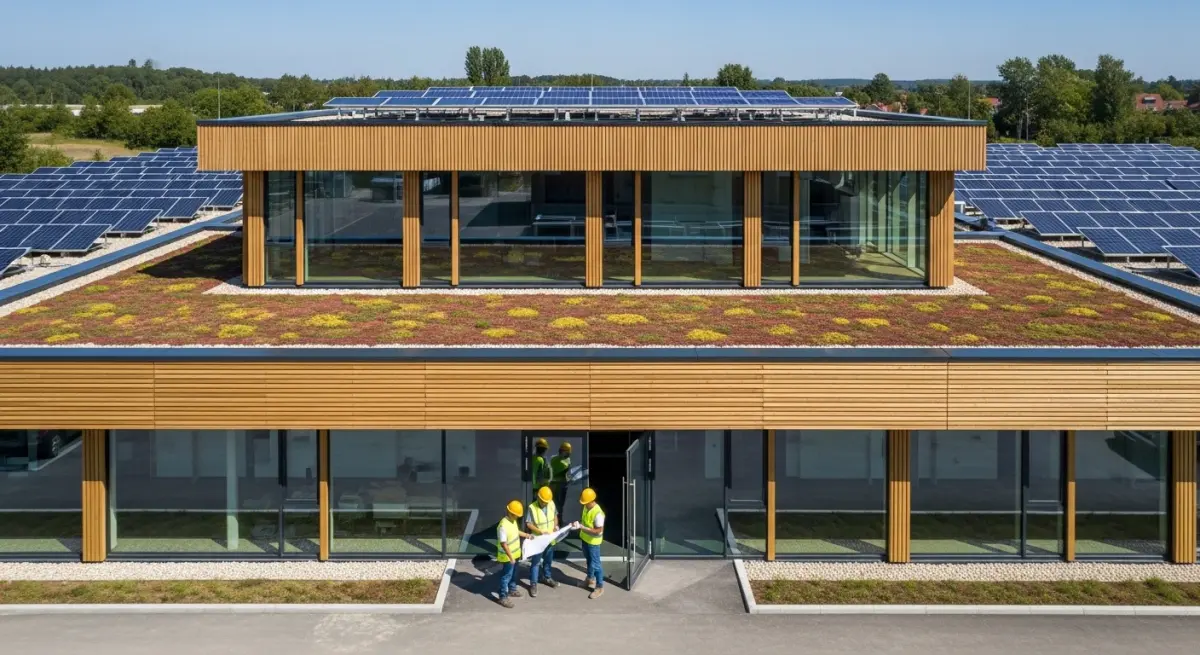
Green building is not a fad. If you have been in construction for any length of time, you have watched the market shift. Clients who used to treat energy efficiency as a nice-to-have are now putting it at the top of their project requirements. Government agencies are mandating sustainability standards for new builds. And the contractors who saw this coming are now pulling in jobs that the rest of the industry is fighting over.
The good news? It is not too late to get in. But you need to understand what these certifications actually require, what they cost, and how to use them to grow your business. This guide breaks down the five major green building certifications and shows you how to turn them into a real competitive advantage.
LEED: The Gold Standard That Opens Doors
LEED (Leadership in Energy and Environmental Design) is the certification most people think of when they hear “green building.” Run by the U.S. Green Building Council, it has been around since 1998 and has become the most widely recognized green building rating system in the world. Over 100,000 projects across 180 countries have used LEED.
For contractors, LEED matters because it is often a requirement on government and institutional projects. If you want to bid on schools, hospitals, municipal buildings, or large commercial projects, having LEED experience on your resume makes a real difference. Many RFPs will not even consider you without it.
LEED rates buildings across several categories: energy performance, water efficiency, materials selection, indoor environmental quality, and site sustainability. Projects earn points in each category and receive a certification level: Certified, Silver, Gold, or Platinum.
What it takes to get started: Your first step is getting at least one person on your team credentialed as a LEED Green Associate or LEED AP (Accredited Professional). The Green Associate is the entry point and costs about $250 for the exam. The LEED AP with specialty designation runs around $550. Study time is real, usually 4 to 12 weeks depending on the credential level.
The practical side: LEED projects require detailed documentation throughout construction. You will need to track material sourcing, waste diversion rates, indoor air quality measures, and energy system commissioning. This is where having solid project management systems pays off. If your documentation game is weak, LEED projects will expose that fast.
Cost considerations: Beyond credential fees, LEED project registration runs $1,200 to $3,000 for most projects, with certification review fees on top of that. The real investment is in training your crew to follow LEED protocols on site, particularly around waste management and material handling.
ENERGY STAR: The Accessible Starting Point
If LEED feels like jumping into the deep end, ENERGY STAR is the shallow end with a clear path to deeper water. Most people know ENERGY STAR from appliance labels, but the certification program for buildings and homes is a powerful credential for contractors.
ENERGY STAR Certified Homes must meet strict energy performance standards set by the EPA. A certified home typically uses 15 to 30 percent less energy than a standard code-built home. For commercial projects, ENERGY STAR certification means the building performs in the top 25 percent of similar buildings nationwide.
Why contractors should care: ENERGY STAR certification is highly marketable to homebuyers and commercial tenants who are watching their utility bills. It gives you a concrete, third-party-verified claim to make in your marketing. Instead of saying “we build energy-efficient homes,” you can say “we build ENERGY STAR Certified homes that use 20 percent less energy than code minimum.”
Getting started: To build ENERGY STAR Certified Homes, you need to partner with a certified Home Energy Rater (HERS rater) who will verify your work. You do not need personal certification, but you do need to follow the ENERGY STAR construction specifications. These cover insulation, air sealing, HVAC installation, windows, and lighting.
Thousands of contractors have made the switch. See what they have to say.
The learning curve is manageable for most experienced builders. If you are already building to current energy codes, you are probably 70 to 80 percent of the way there. The remaining gap usually comes down to tighter air sealing details and verified HVAC installation quality.
Pairing with your business strategy: ENERGY STAR works especially well as a starting certification because the principles overlap heavily with other programs. Once your crews are trained on ENERGY STAR building practices, moving toward LEED or Passive House becomes a much shorter leap. If you are growing your construction business, adding ENERGY STAR capabilities is one of the fastest ways to differentiate yourself in a crowded market.
National Green Building Standard (NGBS): The Residential Specialist
The National Green Building Standard, developed by the National Association of Home Builders (NAHB) and the ICC, is specifically designed for residential construction. If your work is primarily single-family homes, multifamily buildings, or residential remodels, NGBS deserves a close look.
NGBS rates projects across six categories: lot design and development, resource efficiency, energy efficiency, water efficiency, indoor environmental quality, and building operation and maintenance. Like LEED, it uses a tiered system: Bronze, Silver, Gold, and Emerald.
What sets it apart: NGBS was built by homebuilders for homebuilders. The requirements are practical and achievable without exotic materials or techniques. Many of the credits align with things good builders are already doing, like proper grading and drainage, efficient framing techniques, and quality HVAC installation.
The certification process: Projects are verified by an NGBS Green Verifier who inspects the home at rough-in and final stages. Verifier fees typically run $500 to $2,000 per home depending on size and location. You can also get your own team members trained as NGBS Green Verifiers, which pays for itself quickly if you are building volume.
Builder certification: NAHB offers a Certified Green Professional (CGP) designation for individual builders and remodelers. The course takes about 24 hours of instruction plus an exam. It is a solid credential to put on your business cards and marketing materials, and it signals to clients that you take sustainable building seriously.
For contractors who are managing multiple residential projects, keeping track of NGBS documentation alongside your regular project workflows is critical. Using a construction scheduling system that lets you build verification milestones into your project timeline keeps nothing falling through the cracks.
Passive House: The Performance Standard for Serious Builders
Passive House (or Passivhaus, after its German origins) is the most rigorous energy performance standard on this list. A Passive House building uses up to 90 percent less heating and cooling energy than a conventional building. That is not a typo.
The standard achieves this through five core principles: continuous insulation with no thermal bridges, an airtight building envelope, high-performance windows and doors, balanced heat and moisture recovery ventilation, and minimal space conditioning. Every Passive House project must meet strict performance thresholds verified through energy modeling and on-site blower door testing.
Why it matters for your business: Passive House is a premium service. Clients who want Passive House certification are typically well-informed, willing to invest in quality, and expect top-tier craftsmanship. These are the kinds of clients every contractor wants. The projects carry higher margins and tend to involve less nickel-and-diming because the client has already committed to paying for performance.
The learning curve: This is where Passive House differs from the other certifications. You cannot just follow a checklist. Your crews need to truly understand building science: how heat moves through assemblies, where air leakage happens, and why sequencing matters during installation. A single missed detail in the air barrier can blow the whole blower door test.
Training options include the Certified Passive House Builder (CPHB) credential through the Passive House Institute (PHI) or the Certified Passive House Consultant (CPHC) through the Passive House Institute US (PHIUS). Courses run 3 to 5 days of intensive instruction plus an exam. Budget $1,500 to $3,000 per person for training.
The build cost reality: Passive House projects typically cost 5 to 15 percent more than conventional construction. Most of that premium goes to better windows, thicker insulation, and the ERV/HRV ventilation system. The cost premium has been dropping steadily as more manufacturers offer Passive House-suitable products and more builders develop efficient installation methods.
If you are considering Passive House work, start by sending one or two of your best people to training while continuing to build your green building track record with ENERGY STAR or NGBS projects. Having a background in environmental compliance also helps your team understand the regulatory context around high-performance building.
Living Building Challenge: The Pinnacle of Sustainable Construction
The Living Building Challenge (LBC), created by the International Living Future Institute, is the most ambitious green building certification in existence. Where other programs set performance targets, LBC requires that buildings actually generate more energy than they use, capture and treat all their own water, and use materials that meet strict toxicity and sourcing standards.
LBC organizes its requirements into seven “petals”: Place, Water, Energy, Health and Happiness, Materials, Equity, and Beauty. Yes, beauty. LBC requires that buildings include elements designed purely for the human spirit, like public art or spaces that connect occupants to nature.
The reality check: Very few buildings have achieved full Living Building certification. As of 2025, fewer than 50 projects worldwide carry the full LBC designation. This is not a certification most contractors will pursue in its entirety. However, understanding it matters for two reasons.
First, some clients and architects will reference LBC principles even if they are not pursuing full certification. Being conversant in LBC language positions you as a knowledgeable partner in those conversations.
Second, LBC offers a “Petal Certification” option where projects can pursue one or more petals without meeting all seven. The Net Zero Energy petal and the Water petal are the most commonly pursued and are achievable for contractors who already have Passive House or advanced LEED experience.
Material considerations: The LBC Red List is a catalog of materials and chemicals that cannot be used in a Living Building. This includes common construction materials like PVC, formaldehyde-added wood products, and certain flame retardants. Handling the Red List requires careful material sourcing and close coordination with your supply chain. This is where thorough bid management processes become essential, because you need to verify material compliance before you commit to pricing.
Marketing Your Green Building Capabilities to Clients
Having certifications is only half the equation. If potential clients do not know about your green building capabilities, those credentials are just expensive wall decorations. Here is how to actually turn your green building skills into revenue.
Lead with results, not acronyms. Most clients do not care whether you are LEED AP or NGBS Green Certified. They care about lower utility bills, healthier indoor air, higher resale values, and buildings that perform well for decades. Frame your marketing around outcomes. “Our ENERGY STAR Certified homes save owners an average of $1,200 per year on energy bills” hits harder than “We are ENERGY STAR certified builders.”
Build a portfolio of green projects. Document every green building project with professional photos, energy performance data, and client testimonials. Before-and-after energy data is especially powerful. If you built an ENERGY STAR home that tested at HERS 45 when code minimum is around 55 to 60, that is a concrete story you can tell. Track these numbers in your project management software so you have data ready when a prospect asks about your track record.
Target the right clients. Green building clients tend to be more educated about construction, more willing to invest in quality, and less likely to choose purely on lowest price. They research builders carefully and value expertise over bargain pricing. Your marketing should meet them where they are: detailed case studies on your website, educational blog posts about building science, and active presence in local green building organizations.
Get involved in the green building community. Join your local USGBC chapter, attend Passive House conferences, and participate in green building home tours. These events connect you with architects, engineers, and clients who are already committed to sustainable building. Word-of-mouth referrals from the green building community can fill your pipeline with high-quality projects.
Price your expertise appropriately. Green building skills are specialized knowledge. Do not give them away by pricing green projects the same as conventional work. Your estimating process should account for the additional training, documentation, and quality control that green certifications require. Clients who understand the value of certified green building will pay for it. Those who will not are probably not your target market anyway.
Use certifications in your pre-qualification materials. When responding to RFPs or submitting pre-qualification packages, list your team’s green building credentials prominently. Include the number of certified projects you have completed, the certification levels achieved, and any ongoing training your team participates in. For government work especially, this information often carries significant weight in the selection process.
Tell the story on social media. Post progress photos from green building projects with educational captions. Explain why you are installing a particular air barrier detail or what makes your window installation different from standard practice. This kind of content attracts exactly the type of client who values quality work and is willing to pay for it. Good client communication starts before someone ever picks up the phone to call you.
Getting Started: A Practical Roadmap
If you are reading this and feeling overwhelmed by the number of certifications and options, here is a simple path forward:
Year one: Pick one certification that fits your current work. For residential builders, start with ENERGY STAR or NGBS. For commercial contractors, start with LEED Green Associate credentials. Send one or two team members to training and complete your first certified project.
Year two: Build on your first certification by completing several more certified projects. Start documenting results and building your green building portfolio. Begin marketing your capabilities and tracking lead sources to see what is working.
Year three: Consider adding a second certification. If you started with ENERGY STAR, look at NGBS or begin exploring Passive House. If you started with LEED Green Associate, pursue the full LEED AP credential and consider WELL or Fitwel certifications for indoor health.
The contractors who will thrive in the next decade are the ones building real expertise now. Green building is not going away. Building codes are getting stricter, client expectations are rising, and the market is rewarding companies that can deliver verified performance. The certifications covered here give you a clear path to being one of those companies.
See how Projul makes this easy. Schedule a free demo to get started.
Start with what makes sense for your business, invest in your team’s training, document your results, and tell your story. The projects will follow.
Frequently Asked Questions
Which green building certification is easiest for a small contractor to start with?
How much does it cost to get LEED certified as a construction company?
Do green building certifications actually help contractors win more work?
Can I pursue multiple green building certifications at once?
How long does it take to become a LEED Accredited Professional?
Related Articles

BIM Clash Detection: How to Catch Conflicts Before They Cost You on the Jobsite
BIM Clash Detection: How to Catch Conflicts Before They Cost You on the Jobsite Every contractor has a story about the...
Read More →
Asphalt Paving and Compaction Guide: Mix Types, Laydown Temperatures, and Quality Testing
Asphalt paving looks straightforward from a distance. A truck dumps material, the paver lays it down, and rollers...
Read More →
Construction Jobsite Wi-Fi & Connectivity Guide: Setting Up Reliable Internet in the Field
A practical guide to getting reliable internet on construction job sites. Learn about cellular hotspots, mesh networks,...
Read More →