
Healthcare & Hospital Construction Guide for Contractors | Projul
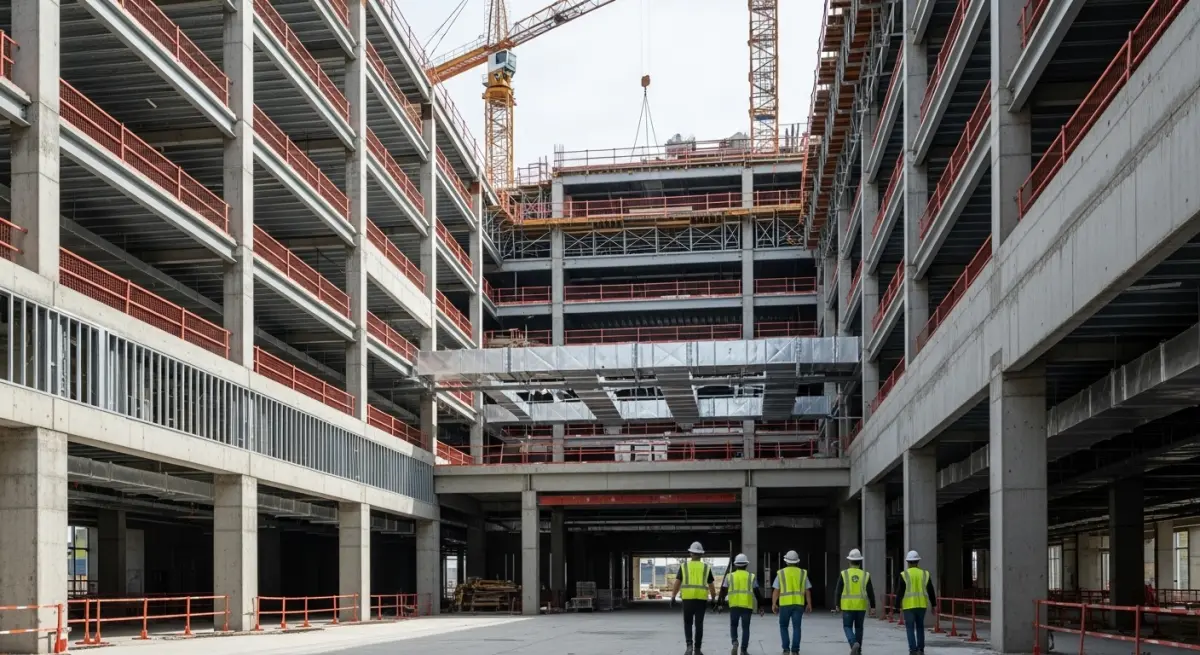
Healthcare construction is one of the most demanding sectors in the building industry. From infection control risk assessments to med gas piping and radiation-shielded rooms, hospital projects carry requirements that most commercial builds never touch. The stakes are higher, the inspections are tougher, and the coordination between trades gets complicated fast.
If you have ever worked on a hospital project, you know the learning curve is steep. If you have not, this guide will walk you through the major systems and protocols that set healthcare construction apart from everything else you have built.
Understanding Infection Control Risk Assessments (ICRA)
The single biggest difference between hospital construction and standard commercial work is the ICRA. Before you swing a hammer, drill a hole, or pull a single tile, you need a signed-off Infection Control Risk Assessment that spells out exactly what containment measures your crew will follow.
The ICRA process starts with two questions: what type of construction activity are you performing, and what patient population is nearby? The answers land you in a matrix that ranges from Class I (minor work with no dust) to Class IV (major demolition and new construction). Each class dictates specific containment requirements.
For Class III and Class IV projects, you are typically looking at full barrier walls from floor to deck, sealed with tape and caulk. Negative air machines run 24/7 to keep dust and particulates from migrating into patient areas. Your crew enters and exits through designated pathways, often with sticky mats at every transition point. Debris goes out in sealed carts or through chutes that dump into covered dumpsters.
Here is the part that catches new hospital contractors off guard: the infection control department can shut you down on the spot. If a nurse walks by your work area and sees dust escaping, or if your negative air machine stops running and nobody notices, your project stops. No warnings, no second chances. You pull your crew off the floor until the infection preventionist clears you to restart.
Tracking ICRA compliance across multiple work areas on multiple floors is exactly the kind of coordination nightmare that construction management software was built to handle. Every daily check of your barriers, every filter change on your negative air machines, every sign-off from infection control needs to be documented and time-stamped.
The smartest hospital contractors build ICRA checkpoints directly into their scheduling software. Before any task in a patient-adjacent area can start, the preceding ICRA verification task must be marked complete with photo documentation attached.
HVAC Air Handling Requirements for Healthcare Facilities
If you thought commercial HVAC was complicated, hospital air handling is a different animal entirely. ASHRAE Standard 170 governs ventilation requirements for healthcare facilities, and it assigns specific air change rates, pressure relationships, temperature ranges, and humidity levels to dozens of different room types.
An operating room requires a minimum of 20 total air changes per hour, with at least 4 of those being outside air. The room must maintain positive pressure relative to the corridor so that clean air pushes outward, keeping contaminants from drifting in. Filtration must include at least two filter banks, with the final filter rated at MERV 14 or higher. Some facilities spec HEPA filtration for their ORs.
Flip over to an airborne infection isolation (AII) room, and the pressure relationship reverses. These rooms run at negative pressure so that air flows inward from the corridor, trapping any airborne pathogens inside the room where they get exhausted directly outside or through HEPA filtration. The pressure differential must be continuously monitored with a visual indicator at the door.
Contractors across the country trust Projul to run their businesses. Read their reviews.
Then you have protective environment (PE) rooms for immunocompromised patients, which need positive pressure with HEPA-filtered supply air and at least 12 air changes per hour. Some rooms need both AII and PE capabilities with an anteroom that acts as an airlock between the two pressure zones.
The ductwork installation for these systems demands airtight construction. Round spiral duct with gasketed joints is common in hospital work. Every duct run gets leak tested, and the acceptable leakage rate is far tighter than what you would see in an office building. Duct cleaning before system startup is mandatory, and the facility will often require a third-party air balancing report before they accept any system.
For contractors managing multiple HVAC zones across a hospital project, keeping track of which rooms need which pressure relationship, which systems have been tested, and which are still waiting on balancing reports is a lot of moving parts. A solid job management system keeps your mechanical subs accountable and gives you a clear picture of what is done and what is still outstanding.
Medical Gas Rough-In and Testing
Medical gas systems are life-safety systems, full stop. Oxygen, medical air, nitrogen, nitrous oxide, vacuum, and waste anesthetic gas disposal (WAGD) lines run throughout a hospital, and every single joint in those systems must be brazed by an ASSE 6010 certified installer using nitrogen purge to prevent oxidation inside the pipe.
The pipe itself is Type L or Type K copper, cleaned and capped specifically for medical gas service. You do not pull this pipe from the same rack as your domestic water copper. Medical gas tube comes sealed from the factory, and it stays capped until the moment you are ready to make a joint. Any pipe left open and uncapped gets rejected.
Testing is where medical gas work gets really intense. Every brazed joint is individually tested with nitrogen at 150 PSI and held for 24 hours. After the initial pressure test passes, the system goes through a standing pressure test, a cross-connection test to verify that oxygen outlets deliver oxygen and not nitrogen, and finally a purity test that checks for particulates, moisture, and hydrocarbon contamination.
The documentation requirements are massive. Every joint needs a log entry. Every test needs recorded results with the tester’s certification number. Every outlet gets labeled and verified against the construction documents. When the state inspector and the facility’s medical gas committee review your package, a missing test result or an unsigned log sheet can hold up the entire project.
This is where digital documentation pays for itself many times over. Instead of binders full of handwritten test logs that can get lost, damaged, or misfiled, digital document storage lets you attach test results, certification photos, and inspection sign-offs directly to the task they belong to. When the inspector asks for the purity test results on the third-floor oxygen zone, you pull it up on a tablet in seconds instead of flipping through a three-inch binder.
Building Radiation-Shielded Rooms
Shielded rooms for imaging equipment and radiation therapy are some of the most specialized spaces in healthcare construction. The shielding design comes from a qualified medical physicist who calculates the required lead equivalency based on the equipment being installed, the room’s use factor, and the occupancy of adjacent spaces.
For a standard X-ray room, you might be looking at 1/16-inch lead sheeting on the walls up to seven feet, with the area above that height unshielded or lightly shielded depending on the physicist’s calculations. A CT suite typically needs heavier shielding, and a linear accelerator vault can require walls that are four to six feet of high-density concrete with rebar so tight you can barely fit a vibrator between the bars.
The critical detail with shielded construction is continuity. Every single penetration through a shielded barrier must be addressed. An electrical conduit punched through a lead-lined wall needs a lead collar or pour-back to maintain the shielding integrity. Ductwork penetrations get lead-lined sleeves. Even the door frame and door leaf carry lead, and the overlap between the door and frame must prevent any direct line of sight through the gap.
Coordination between trades is where shielded room construction gets messy. Your electrician drills a hole for conduit, and suddenly you have a radiation leak path that needs to be patched by the lead installer. Your plumber runs a waste line through the floor slab, and the shielding continuity at that penetration needs verification. Every trade touching a shielded room needs to understand that unauthorized penetrations are not just a punch list item but a safety violation.
Using subcontractor management tools to coordinate these overlapping scopes keeps everyone on the same page. When every trade can see what is happening in the shielded room and when, you avoid the surprise penetrations that cost you time and money to remediate.
Handling Codes, Standards, and Accreditation
Healthcare construction operates under a layered code environment that goes well beyond the standard building code. On top of the IBC, you are dealing with NFPA 101 (Life Safety Code), NFPA 99 (Health Care Facilities Code), and the Facility Guidelines Institute (FGI) Guidelines for Design and Construction of Hospitals.
Then there is the Joint Commission, or whichever accreditation body the facility uses. These organizations conduct surveys that evaluate not just the finished building but how it was built. They want to see that infection control protocols were followed during construction, that fire safety systems were maintained throughout the project, and that interim life safety measures (ILSM) were properly documented.
Interim life safety measures are a big deal on renovation projects in occupied hospitals. When your construction work compromises an existing fire barrier, smoke compartment, or means of egress, you need an ILSM plan that details what temporary measures are in place. That might mean fire watch personnel, temporary smoke barriers, additional fire extinguishers, or revised evacuation routes. The ILSM plan lives as a document that gets updated every time conditions change, and the facility’s safety officer reviews it regularly.
Above-ceiling work in hospitals requires a permit from the facility before you open a single tile. The permit process typically involves notifying infection control, verifying that the ICRA is in place, and confirming that any fire-rated assemblies you are breaching will be restored before the end of the shift. Leaving a fire-rated ceiling open overnight without a fire watch is a violation that accreditation surveyors specifically look for.
Keeping all of these permits, plans, and compliance documents organized across a multi-phase hospital project is brutal on paper. Digital systems that let you attach documents to specific locations and tasks, set up approval workflows, and generate compliance reports on demand are not luxury items on hospital jobs. They are survival tools. If you are still running your projects off spreadsheets, a healthcare build will expose every gap in your project management process.
Managing Healthcare Construction Projects with Software
Hospital construction projects generate more paperwork, more inspections, and more coordination demands than nearly any other building type. The number of hold points alone, where work cannot proceed until a specific inspection or sign-off happens, can number in the hundreds on a mid-size hospital renovation.
Traditional project management methods break down under this kind of load. Whiteboards cannot track 200 hold points across 15 floors. Spreadsheets cannot alert you when a negative air machine filter has not been changed in 72 hours. And paper binders full of test results do not help you when an inspector on the sixth floor asks for documentation that is sitting in a trailer three buildings away.
Construction project management software built for the field gives you a fighting chance. Here is what matters most on healthcare projects:
Task dependencies with hold points. Your scheduling system needs to enforce the rule that certain tasks cannot start until prerequisite inspections are complete. When your ICRA verification is linked as a predecessor to the demolition task, nobody starts swinging until infection control has signed off.
Photo and document attachment at the task level. Every inspection, every test, every barrier check needs photo evidence tied to the specific work item it relates to. When you are defending your work during a Joint Commission survey six months after you left the site, those photos are your proof.
Real-time communication across trades. On a hospital job, your mechanical sub needs to know that the electrician just punched through a shielded wall. Your infection control monitor needs to know that demo is starting on the fourth floor in two hours. Construction communication tools that push notifications to the right people at the right time prevent the costly mistakes that come from information gaps.
Subcontractor coordination and accountability. Hospital projects typically involve more specialty subcontractors than standard commercial work. Med gas installers, lead-lined drywall crews, controls contractors for pressure monitoring, medical equipment vendors coordinating rough-in dimensions. Keeping all of these teams aligned on schedule and scope requires a system that gives everyone visibility into what is happening and when.
Document control and compliance reporting. At the end of a hospital project, you are handing over a closeout package that can fill a bookshelf. O&M manuals, as-built drawings, test reports, warranty documents, training records, and commissioning reports all need to be organized and complete. Starting your document collection on day one with a digital system means you are not scrambling during the last two weeks of the project trying to chase down paperwork from subs who have already moved on to their next job.
The contractors who succeed in healthcare construction are the ones who treat documentation and compliance as part of the production work, not as an afterthought. When your time tracking and task management system captures compliance activities alongside production activities, you get a complete picture of where your project stands and where the risks are hiding.
Want to see this in action? Get a live demo of Projul and find out how it fits your workflow.
Healthcare construction is not going away. An aging population, advancing medical technology, and facilities that need constant renovation to keep up with changing standards mean there is plenty of work in this sector for contractors who are willing to learn the rules and invest in the systems to manage them. The learning curve is real, but so is the opportunity.
Frequently Asked Questions
What is an ICRA in healthcare construction?
Why is HVAC so complicated in hospital construction?
What certifications do I need for medical gas installation?
How does construction project management software help with healthcare builds?
What is a shielded room in hospital construction?
Related Articles

Construction CRM vs Generic CRM: Why Industry-Specific Matters
Salesforce and HubSpot are great CRMs. They're just not built for contractors. Here's why construction-specific CRMs...
Read More →
How to Choose Construction Management Software in 2026
Picking construction management software is a big decision. Here's how to cut through the noise, avoid the traps, and...
Read More →
Construction Invoice Software That Integrates with QuickBooks
Double-entering invoices into QuickBooks is a waste of your time. Here's how to find construction invoicing software...
Read More →