
Scaffolding Types and Safety Guide: Frame, Systems, Mast Climbing, and Suspended Scaffolding | Projul
Scaffolding Is Not Optional
Every year, OSHA reports that scaffolding violations rank in the top 10 most cited standards across all industries. Falls from scaffolds account for a significant portion of construction fatalities and serious injuries. The reasons are almost always the same: incomplete platforms, missing guardrails, poor access, overloading, or inadequate foundations.
None of these failures are mysterious. They are all preventable with proper planning, the right equipment, trained crews, and consistent inspection. Yet scaffolding incidents keep happening because too many contractors treat scaffold erection as an afterthought instead of a critical part of the job plan.
This guide covers the major scaffolding types used in commercial and residential construction, the erection and dismantling process, OSHA compliance requirements, and practical inspection procedures. Whether you are running your own crews or hiring a scaffolding subcontractor, you need to understand this material.
Frame Scaffolding (Tubular Welded Frame)
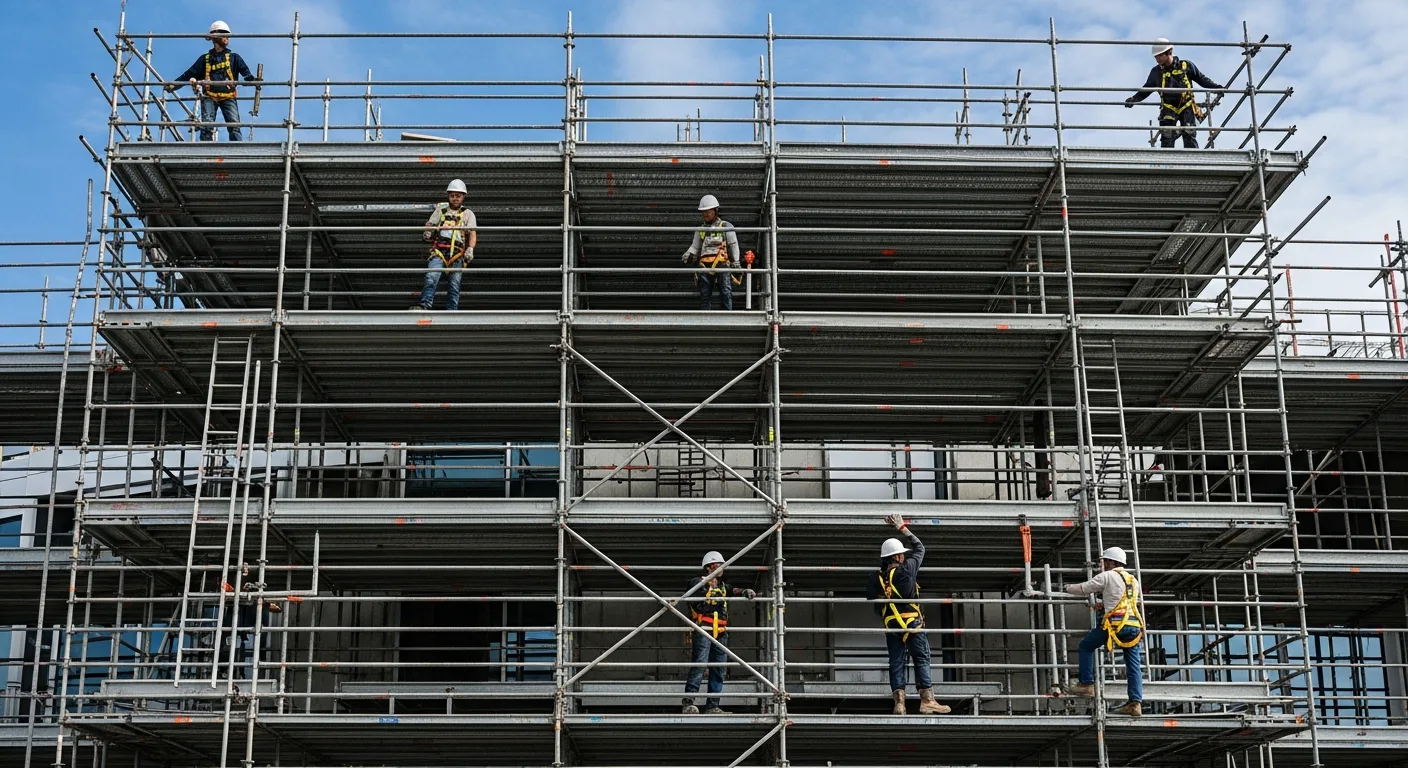
Frame scaffolding is the most common type on residential and light commercial projects. You have seen it on every other job site: rectangular steel frames stacked vertically, connected by cross-braces, and topped with plank platforms.
How It Works
Each frame consists of two vertical legs connected by horizontal members. Frames stack on top of each other using coupling pins. Cross-braces run diagonally between frames to provide lateral stability. Platforms (wood planks or aluminum/plywood decks) sit on the frame’s horizontal members.
Best Uses
- Residential siding, painting, and masonry
- Building facades up to about 60 feet (taller with engineering)
- Projects where the scaffold stays in one location for the duration
- Straightforward wall geometries without many offsets or curves
Advantages
- Low cost per section
- Simple to erect with basic training
- Widely available from rental yards
- Components are interchangeable between most manufacturers
Limitations
- Heavy and time-consuming to erect at greater heights
- Does not adapt well to irregular building shapes
- Requires significant storage space for components
- Limited to standard frame widths (typically 5 feet)
Erection Basics
- Level the ground. Use mudsills (2x10 or larger planks) under every base plate. On sloped ground, use screw jacks to level. Never stack blocks, bricks, or loose material under legs.
- Set base plates and screw jacks. Center each leg on the base plate. Adjust screw jacks so the first frame set is plumb and level.
- Install the first frame set. Place two frames parallel, connect with cross-braces. Check plumb in both directions.
- Add platforms. Secure platforms at the working level. Platforms must extend over their supports by at least 6 inches but no more than 12 inches (18 inches for fabricated platforms).
- Stack additional lifts. Install coupling pins, stack the next frame set, cross-brace, and platform. Check plumb every lift.
- Tie to the structure. At a 4:1 height-to-base ratio, install ties to the building. Continue tying at intervals per the manufacturer’s specs or engineering.
- Install guardrails. Top rail, mid rail, and toeboard on all open sides at every working level.
- Install access. Attach a ladder or install a stair tower. Workers must have a way to reach each platform level without climbing the cross-braces.
Systems Scaffolding (Ring-Lock and Cup-Lock)
Systems scaffolding uses a modular design with rosettes, cups, or rings welded to vertical standards at fixed intervals. Horizontal and diagonal members lock into these connection points, creating a rigid, versatile structure.
How It Works
Vertical standards (posts) have connection nodes at regular spacing, usually every 500mm (about 20 inches). Ledgers (horizontal members) and braces snap or wedge into these nodes, allowing the scaffold to be configured in nearly any shape: straight runs, corners, curves, and cantilevers.
Best Uses
- Commercial and industrial projects
- Complex building geometries
- Shoring and support applications
- Long-term projects where efficiency of erection pays off
- High-rise work
Advantages
- Faster erection and dismantling than frame scaffold
- Fewer loose components (no separate cross-braces)
- Stronger connections with higher load capacity
- Adapts to irregular building shapes
- Can be configured as shoring towers
Limitations
- Higher purchase or rental cost per component
- Requires trained erectors familiar with the system
- Components are proprietary (Brand A does not connect to Brand B)
- Heavier individual components than frame scaffold
Common Systems
- Layher Allround: German-engineered, widely used worldwide
- Haki/PERI: Popular in commercial and industrial markets
- Safway/BrandSafway: Common in North American industrial work
- Cuplock (WACO): Older but still widely used, especially in forming applications
Mast Climbing Work Platforms (MCWPs)
Mast climbing platforms are motorized platforms that travel vertically on one or two mast columns attached to the building or sitting on the ground. Think of them as a movable scaffold that rides up and down the building face.
How They Work
A steel mast (or twin masts) is anchored to the building facade or founded on a ground base. A motorized platform wraps around the mast and climbs using a rack-and-pinion or screw-drive mechanism. Workers ride the platform up, do their work, and ride it down. The mast extends as the platform climbs higher.
Best Uses
- High-rise facade work: cladding, glazing, siding, painting
- Projects where the work moves steadily from bottom to top (or top to bottom)
- Masonry on tall buildings
- Any application where continuous scaffold across the facade would be excessive
Advantages
- One platform replaces dozens of scaffold lifts
- Workers always work at a comfortable height (platform adjusts continuously)
- Much faster setup than full scaffold on tall buildings
- Higher productivity since workers are not climbing ladders between levels
Limitations
- High daily rental cost
- Requires trained operators
- Platform width is limited (typically 6 to 20 feet)
- Needs building attachment points or adequate ground foundation
- Not practical for buildings under 3 to 4 stories
Safety Considerations
MCWPs are rated machines, not passive structures. Operators need equipment-specific training, daily pre-operation inspections, and understanding of wind speed limits (typically 25 to 35 mph maximum operating wind speed). Overloading a mast climber is extremely dangerous since the platform can stall, slip, or collapse.
Suspended Scaffolding
Suspended scaffolding hangs from the top of a building on wire ropes and is raised or lowered with powered or manual hoists. The most common form is the two-point suspended scaffold (swing stage).
How It Works
Outrigger beams or roof-mounted davit arms extend over the building edge. Wire ropes attach to these supports and run down to a platform below. Electric or manual hoists on the platform control the height. Workers ride the platform up and down the building face.
Best Uses
- Window washing and exterior maintenance on existing buildings
- Facade repairs, caulking, and painting
- Buildings where ground-based scaffold is impractical (over roadways, water, etc.)
- Tall buildings where mast climbers are not feasible
Advantages
- Minimal ground-level footprint
- Can reach areas that ground-based scaffold cannot
- Relatively fast to set up on the roof
- Good for maintenance and repair work on occupied buildings
Limitations
- Limited platform size and load capacity
- Affected by wind more than ground-based systems
- Requires overhead structural capacity to support the loads
- OSHA has specific and detailed requirements for suspended scaffolds
Critical OSHA Requirements for Suspended Scaffolds
- Wire ropes must be capable of supporting at least 6 times the intended load
- Workers must wear personal fall arrest systems (harnesses) tied off to an independent lifeline
- The lifeline must be independent of the scaffold suspension ropes
- Hoists must have a secondary braking system
- A competent person must inspect the system before each shift
OSHA Scaffolding Standards: What You Need to Know
OSHA’s scaffolding standards live in 29 CFR 1926, Subpart L (Sections 1926.450 through 1926.454). Here are the big-ticket items that get contractors cited most often.
Fall Protection
Every scaffold platform more than 10 feet above a lower level must have fall protection: guardrails, personal fall arrest systems, or both, depending on the scaffold type. For supported scaffolds (frame, systems), guardrails are the standard. For suspended scaffolds, both guardrails and personal fall arrest are required.
Competent Person
OSHA requires a “competent person” to direct scaffold erection, dismantling, moving, and alteration. This person must be able to identify existing and predictable hazards and have the authority to take corrective action. This is not just a title; it is a defined OSHA term with real responsibility.
Training
Every employee who works on a scaffold must be trained by a qualified person to recognize hazards and understand the procedures to control them. Erectors and dismantlers need additional training specific to those tasks. Training must be documented.
Capacity
Scaffolds must be designed to support their own weight plus at least 4 times the maximum intended load without failure. This means you need to know what your workers and materials weigh before you start loading the platform.
Access
Workers must have safe access to scaffold platforms. Acceptable methods include attached ladders, stair towers, ramps, and integral prefabricated frames with climbing capacity. Climbing cross-braces is not permitted on scaffolds (with very limited exceptions for specific frame scaffold types).
Electrical Hazards
Scaffolds must maintain safe clearances from energized power lines. For lines up to 300 volts, the minimum clearance is 3 feet. For lines between 300 volts and 50kV, the minimum is 10 feet. These distances increase for higher voltages.
Scaffold Inspection Checklist
A competent person must inspect every scaffold before each work shift. Here is a practical checklist:
Foundation and Base
- Mudsills are in place, level, and not cracked or splitting
- Base plates are centered on mudsills
- Screw jacks are plumb and within extension limits
- No undermining from rain or excavation
Structure
- All frames, braces, and connections are in place and secure
- No damaged, bent, or corroded components
- Plumb in both directions at every fourth frame (minimum)
- Ties to the building are in place at required intervals
Platforms
- Full width planking (no gaps over 1 inch between planks)
- Planks extend at least 6 inches over supports
- No cracked, warped, or damaged planks
- Platform is clear of excess debris and materials
Guardrails and Access
- Top rail, mid rail, and toeboard on all open sides
- Guardrails are secure and not bent
- Access ladder or stair tower is in place and secure
- Workers do not need to climb over guardrails to access the platform
Fall Protection Equipment
- Harness and lanyard inspections (for suspended scaffold work)
- Lifeline anchors are independent of scaffold supports
- All fall protection is within inspection date
Managing Scaffolding on Your Projects
Scaffolding is one of the biggest hidden costs on commercial projects. Rental charges accumulate daily, and keeping scaffold up longer than planned kills your margins. Efficient scaffold management means planning the erection and dismantling around your project schedule, not as an afterthought.
Using project management tools to schedule scaffold erection, tie scaffold phases to specific work activities, and track daily rental costs helps you stay ahead. When your scaffold sub knows exactly when each section needs to be up and when it can come down, you reduce idle rental days and keep the site clean.
If you are coordinating multiple trades around scaffolding access, Projul’s scheduling features let you assign scaffold zones to specific crews and time slots so nobody is standing around waiting for access. Check out pricing to see how it works for your team size, or book a demo to walk through a scaffold-heavy project scenario.
Planning a Scaffolding Layout
Before any scaffold goes up, you need a plan. On large commercial projects, this plan should be a formal drawing prepared or reviewed by a registered professional engineer. On smaller jobs, it can be a detailed sketch with calculations.
Your scaffold plan should address:
- Building dimensions and geometry: Where does scaffold go? What heights are needed?
- Ground conditions: Soil bearing capacity, grade, drainage, underground utilities
- Loads: How many workers per platform? What materials will be staged?
- Access: Where do workers enter and exit? Where do materials get hoisted?
- Ties: Locations and types of building tie connections
- Duration: How long does each section stay up?
- Dismantling sequence: What comes down first? Does it coordinate with final finishes?
- Adjacent hazards: Power lines, traffic, pedestrians, overhead work
Scaffolding Costs and Budgeting
Scaffold costs break down into several categories:
Rental: Frame scaffold typically rents for $15 to $50 per frame per month, depending on your market and the rental company. Systems scaffold runs higher. Mast climbers and swing stages have daily rates that include the equipment plus mandatory operator/setup charges.
Erection and dismantling labor: Scaffold erector labor rates vary by region but generally run $35 to $65 per hour. A four-person crew can erect approximately 100 to 150 frames per day on straightforward work.
Engineering: If your scaffold requires engineered drawings (anything complex or over standard height), budget $2,000 to $10,000 for engineering depending on complexity.
Inspection: If you use a third-party inspector (recommended on large projects), budget for their time on a weekly or bi-weekly basis.
Damage and loss: Build in a contingency for damaged components. Rental companies charge for bent frames, broken braces, and missing pins.
Common Scaffolding Mistakes
- Starting without level ground. Every scaffolding failure starts at the bottom. If the foundation is not level and stable, nothing above it is safe.
- Skipping ties. Unsecured scaffolding tips over. It is that simple. Follow the manufacturer’s tie requirements exactly.
- Incomplete platforms. Gaps in planking and platforms without guardrails are leading causes of scaffold falls.
- No access plan. If workers do not have a safe way up, they will find an unsafe way up. Cross-brace climbing is one of the most common citations.
- Ignoring weather. High winds, ice, and rain all affect scaffold safety. Have a clear policy for when work stops and when re-inspection is required before restarting.
- No documentation. If you did not write it down, it did not happen. Inspection logs, training records, and scaffold drawings are your defense if something goes wrong.
Wrapping Up
Scaffolding is one of those construction activities that seems simple until something goes wrong. The equipment is straightforward, the OSHA requirements are well-documented, and the inspection process is not complicated. But the consequences of cutting corners are severe: falls from height are among the most common causes of death on construction sites.
Invest in proper training, use the right equipment for the job, inspect before every shift, and document everything. If you are managing scaffold-heavy projects, a good project management system keeps your scaffold schedule tight and your rental costs under control.
Frequently Asked Questions
What are the 4 main types of scaffolding used in construction?
Who is allowed to erect scaffolding on a job site?
How often must scaffolding be inspected?
What is the maximum height for frame scaffolding without engineering?
What are the OSHA guardrail requirements for scaffolding?
Can workers use ladders on scaffolding?
What is the weight capacity of a standard scaffold platform?
Do I need a permit for scaffolding?
Related Articles

OSHA Compliance for Contractors: What You Need to Know in 2026
OSHA fines hit record highs heading into 2026, and new rules are changing how contractors handle everything from heat...
Read More →
Construction Safety Meeting Topics: 20 Toolbox Talk Ideas for 2026
Running out of toolbox talk ideas? These 20 construction safety meeting topics cover everything from fall protection...
Read More →
Construction Site Safety Inspections: Complete Checklist and Process
A practical safety inspection checklist and process that actually prevents accidents instead of just checking boxes.
Read More →