Structural Steel Connection Types: A Contractor's Field Guide | Projul
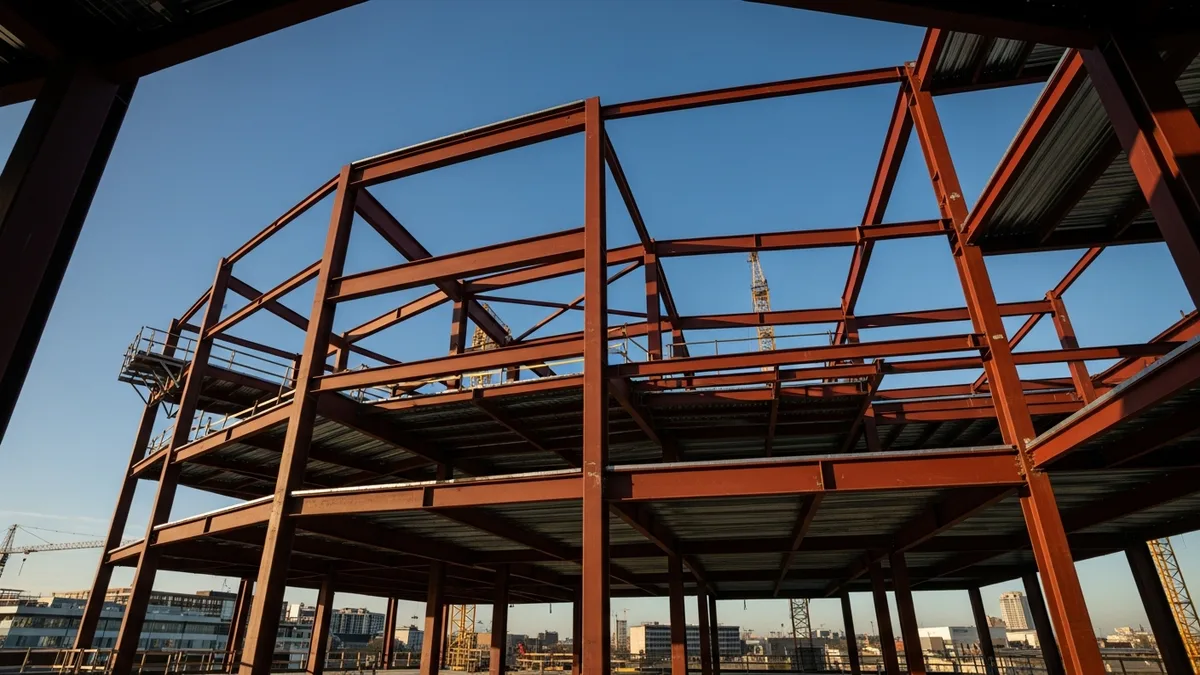
Every piece of structural steel in a building connects to at least one other piece. Those connections are where the engineering meets the iron, and they are some of the most inspection-heavy, schedule-sensitive, and cost-impactful details on any steel project.
If you are a GC running a structural steel job, you do not need to design connections. That is the engineer’s job. But you absolutely need to understand what types of connections are on your project, because connection types affect erection speed, inspection requirements, fabrication lead times, and field labor costs. A project loaded with full-penetration welded moment connections is a completely different animal than one with simple bolted shear tabs.
This guide walks through the major structural steel connection types you will encounter in the field, what makes each one different, and what it means for your project schedule and budget. If you are new to managing steel projects, start with our steel erection management guide for the big-picture coordination overview first.
Bolted Connections: The Workhorse of Steel Erection
Bolted connections are the most common connection type in modern steel construction. They are faster to install than welded connections, easier to inspect, and do not require specialized field labor beyond your ironworkers and a couple of bolt-up crews.
How Bolted Connections Work
A bolted connection uses high-strength structural bolts (typically A325 or A490 grade) to clamp steel members together through pre-punched or pre-drilled holes. The fabricator punches the holes in the shop and ships the pieces ready to bolt. Field crews line up the holes, stick the bolts through, and tension them to the specified level.
There are two main categories:
Bearing-type connections rely on the bolt shank pressing against the sides of the bolt holes to transfer load. These are simpler and used where slight movement at the joint is acceptable.
Slip-critical connections rely on the friction created by the clamping force of fully tensioned bolts. The faying surfaces (the faces of the steel that press together) must be clean and sometimes specially prepared to a certain slip coefficient. These are specified when any slippage would be a problem, like in connections subject to vibration or load reversal.
What This Means on Your Job
Bolted connections are your friend when it comes to schedule. A good bolt-up crew can close out connections quickly, and inspection is straightforward. Your special inspector will check bolt tension using a calibrated wrench, turn-of-nut method, or direct-tension indicators (DTI washers with little bumps that flatten when the bolt reaches proper tension).
The main scheduling risk with bolted connections is hole alignment. If fabrication tolerances are off or the steel is slightly out of plumb, holes will not line up cleanly. Ironworkers will start reaming holes to make things fit, and your inspector may flag those reamed holes. Make sure your quality control plan addresses acceptable hole tolerances before erection starts.
Bolt supply can also sneak up on you. A325 and A490 bolts in the right length and diameter need to be on site in sufficient quantity. Running out of 7/8-inch by 3-inch A325 bolts on a Tuesday morning when the bolt-up crew is ready to work is an avoidable headache.
Welded Connections: When the Joint Needs to Be Rigid
Welded connections fuse two steel members together into what is essentially a single piece of metal. They are the go-to when the structural engineer needs a rigid joint that transfers moment (bending forces) in addition to shear and axial loads.
Types of Structural Welds
Not all welds are created equal, and the weld type dictates how much field time and inspection you are looking at:
Fillet welds are the most common structural weld. They are triangular in cross-section and are placed along the junction of two surfaces (like where a plate meets a beam flange). Fillet welds are relatively fast to run and forgiving to inspect.
Complete joint penetration (CJP) welds are full-penetration welds where the weld metal extends through the entire thickness of the joint. These are the gold standard for moment connections. They are also the most expensive, the most time-consuming, and require the most rigorous inspection (typically ultrasonic testing on every single weld).
Partial joint penetration (PJP) welds penetrate partway through the joint thickness. They fall between fillet welds and CJP welds in both cost and capacity.
Field Welding vs. Shop Welding
A critical distinction for your project planning: shop welding happens at the fabrication plant under controlled conditions with automated equipment. Field welding happens 40 feet in the air, in the wind, possibly in the cold, by a welder working off a man-lift or scaffold.
Field welding is slower, more expensive per inch of weld, and more prone to defects than shop welding. Good structural engineers and fabricators will push as much welding as possible into the shop and design field connections to be bolted wherever they can. If your project has a lot of field welding, that is a schedule and cost flag you need to account for.
Your field welders need to be qualified per AWS D1.1 (the structural welding code), and you will need a special inspector on site whenever field welding is happening. Budget for that inspection time in your project schedule. On a large steel job with significant field welding, your inspection costs alone can run into the tens of thousands.
Shear Connections: Simple, Fast, and Everywhere
Shear connections are the simplest and most common connection type in a typical steel building. They transfer vertical (gravity) loads from beams to columns or girders but do not resist rotation. The joint is free to rotate slightly, which means shear connections are treated as “pinned” in the structural analysis.
Common Shear Connection Configurations
Single-plate shear connections (shear tabs) are a single plate welded to the supporting member in the shop, with the beam bolted to the plate in the field. These are fast to erect because the ironworker just needs to set the beam and stick a few bolts through. You will see shear tabs on the majority of beam-to-girder and beam-to-column connections in most buildings.
Double-angle connections use two angles (one on each side of the beam web) bolted or welded to both the beam and the supporting member. These were the standard for decades before shear tabs became popular. You still see them on older buildings and in some heavy industrial work.
Seated connections use an angle or tee welded to the column that acts as a shelf for the beam to sit on. These are nice for erection because the beam has a physical shelf to land on, making it easier for the connector to set and stabilize the piece.
End-plate connections weld a plate to the end of the beam in the shop. The plate is then bolted to the supporting member in the field. These show up more in pre-engineered metal buildings.
Scheduling Impact
Shear connections are the fastest connections to erect and inspect. If your building is mostly gravity framing with shear connections, your erection and bolt-up will move quickly. This is where your cost tracking should reflect the lower labor hours compared to moment-frame buildings. The difference is significant enough to affect your bid.
Moment Connections: Rigid Frames and Lateral Resistance
Moment connections are the heavy hitters. They create rigid joints between beams and columns that resist not just vertical loads but also the bending and rotation caused by lateral forces (wind and seismic). A building designed as a “moment frame” relies on these connections to keep the structure from swaying.
What Makes a Moment Connection Different
A moment connection typically involves:
- CJP (full-penetration) welds connecting the beam flanges directly to the column flange
- A shear connection (bolted shear tab or web plate) handling the vertical load
- Continuity plates (stiffener plates) inside the column at the beam flange levels to prevent the column from buckling locally
- Sometimes, doubler plates on the column web if the column panel zone is not thick enough
The result is a connection that is much heavier, much more labor-intensive, and much more expensive than a shear connection. On a typical commercial building, moment connections might represent only 10-20% of the total connections, but they can account for 40-50% of the connection-related cost and schedule time.
Seismic Moment Connections
Read real contractor reviews and see why Projul carries a 9.8/10 on G2.
If your project is in a seismic zone, you are dealing with a whole additional layer of requirements. After the 1994 Northridge earthquake in California revealed that standard welded moment connections could fracture under seismic loading, the industry developed pre-qualified seismic connection types. These include:
Reduced beam section (RBS) connections, sometimes called “dogbone” connections, where the beam flanges are intentionally trimmed narrower near the column face. This forces the plastic hinge (the point where the beam will bend and yield under extreme loading) to form in the beam away from the weld, protecting the critical welded joint.
Bolted flange plate connections use thick plates bolted to the beam flanges and welded to the column, providing a different load path than direct flange-to-flange welds.
These seismic connections come with very specific fabrication tolerances, welding procedures, and inspection requirements. Your fabricator needs experience with them, and your special inspector needs to know what to look for. Seismic connection work is not the place to bring in the low-bid fabricator who mostly does warehouse buildings.
If you are managing the overall project coordination, make sure your pre-construction planning accounts for the added engineering review time these connections require. Shop drawing review for seismic moment connections takes significantly longer than standard connections.
Base Plate Connections: Where Steel Meets Concrete
Every steel column has to connect to the foundation somehow. Base plate connections are that interface between the steel superstructure and the concrete below. They might not get as much attention as the connections happening 10 stories up, but a botched base plate layout can shut your steel erection down on day one.
How Base Plates Work
A base plate is a thick steel plate welded to the bottom of the column in the shop. The plate sits on the foundation (usually a concrete pier or spread footing) and is anchored down with anchor bolts embedded in the concrete. Grout is poured between the base plate and the concrete to fill any gap and provide uniform bearing.
The anchor bolt pattern, plate thickness, and connection details all depend on the loads the column is carrying and whether the base is “pinned” (free to rotate) or “fixed” (resisting moment like a rigid frame connection).
The Field Reality
Base plates are where your concrete and steel scopes collide, and coordination between those two trades is critical. The anchor bolts get set in the concrete before the steel shows up, which means:
-
Anchor bolt placement must be precise. Tolerances are tight, typically plus or minus 1/8 inch. If the concrete crew sets anchors outside tolerance, the column base plates will not fit. You are then looking at remedial work like core drilling new holes, using oversized washers, or worst case, reworking the foundation.
-
Anchor bolt elevation matters. The tops of the bolts need to be at the right height for the base plate, nuts, and washers. Too short and you cannot get the nut on. Too long and the bolt sticks up past the nut more than acceptable.
-
Survey and layout verification should happen before the concrete pour and again after the pour, before steel shows up. This is a checkpoint you cannot skip.
Your daily logs should document anchor bolt surveys. If there is a dispute later about who is responsible for a misplaced anchor bolt, that documentation is your evidence.
Base plate grout is another detail that trips up crews. Non-shrink grout is standard, and it needs to be placed after the column is plumbed and the base plate leveled with shims or leveling nuts. The grouting sequence should be in your erection plan.
Bracing Connections: Holding the Frame Together
Braced frames use diagonal members (braces) to provide lateral stability to the building. Where moment frames use rigid beam-to-column connections to resist lateral loads, braced frames use the geometry of the diagonal brace to create a truss-like system that is inherently stiff. The connections where those braces meet the beams and columns are called bracing connections, and they come with their own set of field considerations.
Gusset Plate Connections
The most common bracing connection uses a gusset plate, a flat steel plate that connects the brace to the beam-column joint. The brace is typically bolted or welded to the gusset, and the gusset is welded and/or bolted to the beam and column.
Gusset plates can be large and heavy, especially on seismic braced frames. They need to be detailed carefully because they sit at the intersection of three members (brace, beam, column) and the geometry has to work in three dimensions. Fabrication errors on gusset plates are some of the most common fit-up problems in the field.
Types of Bracing Systems
Concentrically braced frames (CBF) have braces that meet at the beam-column work points. The connections are simpler because everything is axially loaded (tension and compression along the brace centerline).
Eccentrically braced frames (EBF) intentionally offset the brace connection from the beam-column intersection, creating a short segment of beam called a “link” that absorbs seismic energy through yielding. EBF connections are more complex and have strict detailing requirements.
Buckling-restrained braced frames (BRBF) use proprietary brace elements that are designed to yield in both tension and compression without buckling. The connections for BRBFs are unique to the brace manufacturer and require coordination between the structural engineer, brace supplier, and fabricator.
Coordination for Bracing
If your building has braced frames, identify the brace locations early and think about erection sequence. Braces often need to go in during erection (not after) because they provide stability to the partially erected frame. Your project phasing plan should account for brace installation timing.
Also pay attention to clearances. Bracing connections can interfere with MEP routing, and you do not want to discover during fit-out that a duct run conflicts with a gusset plate that is already welded in place. Flag this during your MEP coordination meetings.
Pulling It All Together: Managing Steel Connections on Your Project
Understanding connection types is not about doing the engineer’s job. It is about knowing what you are building so you can manage it properly. Here is what connection knowledge means in practical terms for a GC:
Estimating and bidding: Connection complexity directly affects fabrication cost, erection labor, and inspection costs. A building with 20 moment connections will cost significantly more per ton of steel than the same tonnage with all shear connections. Make sure your estimator understands what the structural drawings are calling for before you put a number on it. Your estimating process should include a connection-type review as a standard step.
Scheduling: CJP welded connections take longer to fabricate, longer to erect, and longer to inspect than bolted shear connections. Build your erection schedule around the most labor-intensive connections, not the average.
Inspection planning: Know your inspection requirements before erection starts. CJP welds typically require ultrasonic testing. Slip-critical bolts require tension verification. Special inspections need to be scheduled with your testing agency, and the inspectors need to be on site when the work is happening, not the next day.
Shop drawing review: Pay attention during shop drawing review. Connection details that look minor on paper (an extra row of bolts, a thicker gusset plate, a change from fillet weld to CJP weld) can have real cost and schedule impacts. Make sure your team reviews shop drawings for constructability, not just structural adequacy.
Change orders: Design changes that affect connection types can have outsized cost impacts. If the engineer changes a shear connection to a moment connection during construction, that is not just swapping a few bolts for welds. It can mean column reinforcement, additional fabrication, more inspection, and schedule delays. Document these changes carefully and price them accurately in your change order process.
Want to put this into practice? Book a demo with Projul and see the difference.
Steel connections are where the theoretical meets the physical. The engineer draws lines on paper, the fabricator turns those lines into steel pieces with holes and plates, and your ironworkers put it all together 50 feet in the air. The better you understand what is happening at each connection point, the better you can keep the whole project on track.
Frequently Asked Questions
What is the difference between a shear connection and a moment connection?
Are bolted connections stronger than welded connections?
What does slip-critical mean for bolted connections?
How do you inspect structural steel connections in the field?
Who designs structural steel connections?
Related Articles
Construction Septic System Installation: What Every GC Needs to Know
Septic systems on rural builds bring unique scheduling, permitting, and soil challenges that can wreck your timeline if...
Read More →
Construction Painting Project Management: Coordinating Interior and Exterior Phases
Painting is one of those trades that touches every other trade on the schedule. Get the sequencing wrong, and you're...
Read More →
Epoxy Flooring and Industrial Coatings: A Contractor's Complete Guide
Epoxy flooring and industrial coatings are high-margin work when you get the process right and a fast way to lose money...
Read More →