
Tilt-Up Concrete Panel Construction Guide for Contractors | Projul
Tilt-up concrete construction has been a go-to method for commercial buildings since the 1960s, and it keeps gaining ground. Warehouses, distribution centers, retail buildings, office parks, and even multi-story mixed-use projects all use tilt-up panels because the method is fast, cost-effective, and durable. If you have been doing concrete work and want to break into tilt-up, or if you are a GC looking to understand the process better before your next project, this guide covers everything from casting bed prep to final panel connections.
The basic idea is simple: you pour concrete panels flat on the ground (usually on the building’s own floor slab), let them cure, then lift them into place with a crane. But “simple” does not mean “easy.” Tilt-up requires serious coordination between your concrete crews, crane operators, structural engineers, and schedulers. Getting any piece wrong can cost you weeks and thousands of dollars.
Planning and Panel Design
Before a single yard of concrete hits the ground, you need a solid plan. Tilt-up panel design starts with the structural engineer, but as the contractor, you need to be involved early. Your input on panel sizes, crane access, and sequencing directly affects constructability and cost.
Panel sizing depends on the building footprint, wall heights, and crane capacity. Most panels range from 20 to 40 feet wide and 20 to 60 feet tall for single-story commercial buildings. Bigger is not always better. Oversized panels require bigger cranes, which means higher rental costs and more complex rigging. Work with your engineer to find the sweet spot between fewer panels (less joint work) and manageable panel weights.
Weight calculations drive your crane selection. A standard 6-inch thick panel at 150 pounds per cubic foot weighs roughly 75 pounds per square foot. A 30-by-40-foot panel comes in around 90,000 pounds. Add embed plates, window openings with steel headers, and reveals, and you are looking at serious tonnage. Get these numbers right early so your crane selection does not become a last-minute scramble.
Architectural details like reveals, rustication strips, and form liner patterns need to be planned before you build your casting beds. Every recess, bump-out, or opening gets formed into the casting bed face-down. If you miss a detail at this stage, you are cutting concrete after the panel is standing, and nobody wants that.
This is where strong project management software pays for itself. Tilt-up projects have dozens of interdependent tasks, and one missed detail in panel design can cascade into weeks of delays. Track every submittal, RFI, and design revision so nothing falls through the cracks.
Casting Bed Preparation
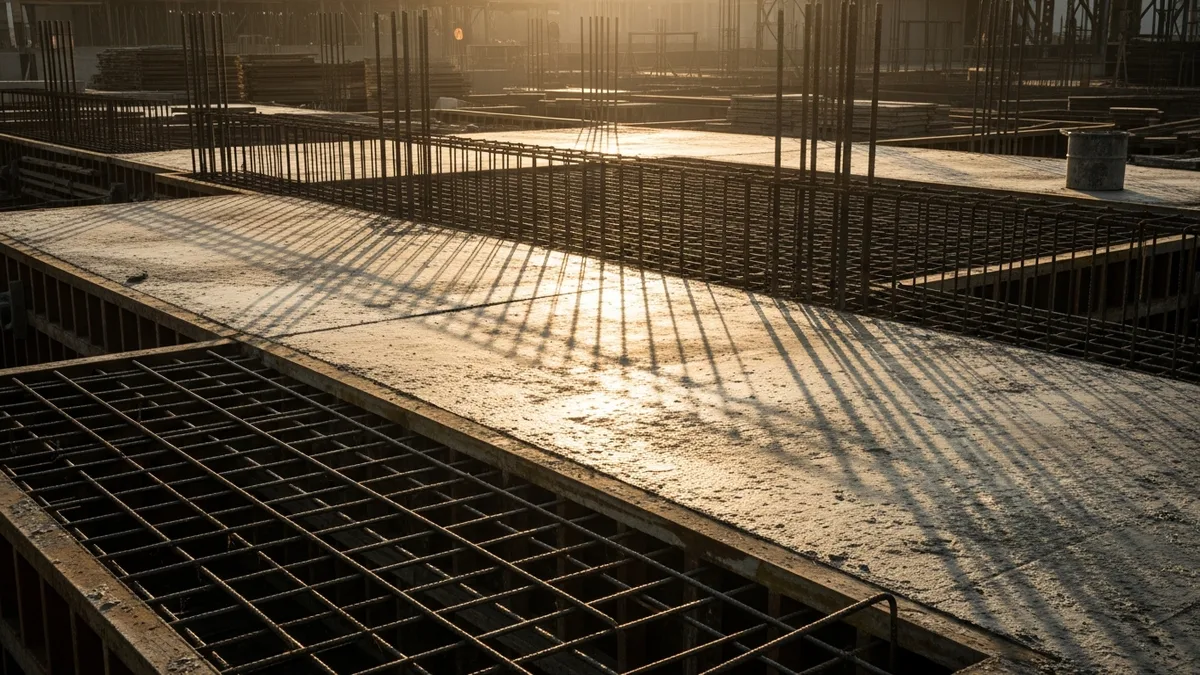
The casting bed is where your panels are born, and its quality determines the quality of your finished panels. Most tilt-up projects use the building’s floor slab as the casting bed, which means your slab has to be poured and finished to a higher standard than a typical warehouse floor.
Slab tolerances for a casting bed are tighter than normal. You need FF25/FL20 minimum, and many specs call for FF35/FL25. Any bump, dip, or crack in the slab transfers directly to your panel face. If your floor crew is not used to tilt-up tolerances, bring in finishers who have done this before. It is not the place to learn on the job.
Bond breakers are applied to the slab surface before you start forming panels. These are chemical compounds (usually wax-based or reactive cure compounds) that prevent the panel concrete from bonding to the slab concrete. Apply them evenly and follow the manufacturer’s directions on coverage rates and drying times. Too little bond breaker and your panel sticks to the slab. Too much and you get surface defects on the panel face.
Stacking panels is common when you have more panels than slab area. You pour one layer, apply bond breaker to the top of those panels, then pour the next set on top. You can stack 2 to 3 layers deep, but each additional layer adds complexity to your erection sequence since you have to lift the top panels first. Plan your stacking layout carefully so your crane sequence makes sense.
Edge forms are typically steel or wood, set to the exact panel dimensions. Brace them well because 6 inches of wet concrete puts serious lateral pressure on forms. Use adjustable steel edge forms where possible since they save setup time and produce cleaner edges than site-built wood forms.
Your construction scheduling software should map out every casting bed activity. Bond breaker application, form setup, rebar placement, embed installation, concrete pours, and curing periods all need to be sequenced correctly. One missed cure day and your entire erection schedule shifts.
Reinforcement and Embed Installation
Rebar and embeds are the skeleton of your tilt-up panels. Get the reinforcement wrong, and you are looking at structural problems that can shut down a project.
Rebar layout for tilt-up panels is typically a two-layer mat of #4 or #5 bars at 12 to 16 inches on center each way. Panel edges, openings, and connection points get additional reinforcement. The engineer’s drawings specify everything, but your crew needs to understand why the rebar goes where it does. Bars around window and door openings take the stress that would otherwise crack the panel during lifting and in service.
Lifting inserts are the most critical embeds in the panel. These are engineered hardware items (typically from manufacturers like Meadow Burke or Dayton Superior) that the crane attaches to for erection. Their placement is calculated based on the panel’s center of gravity, weight distribution, and the rigging geometry. If a lifting insert is off by even a few inches, the panel will not hang plumb during the pick, and you risk cracking the concrete. Always verify insert locations against the engineer’s lift drawings before the pour.
Connection embeds include plates, angles, and weld plates that tie the panels to the building’s structural frame after erection. These are cast into the panel at specific locations so they align with the roof structure, adjacent panels, and foundation connections. Use templates and double-check measurements. A misplaced embed plate means field welding and drilling after the panel is up, which is slow and expensive.
MEP rough-ins can also be cast into tilt-up panels. Electrical conduit, junction boxes, and even plumbing sleeves can be placed before the pour. Coordinate with your mechanical and electrical subs early so their rough-ins are in the forms before concrete day.
Proper rebar placement and reinforcement inspection procedures keep your panels structurally sound. Do not skip the pre-pour inspection with your structural engineer or special inspector. They need to verify bar sizes, spacing, cover, and embed locations before concrete covers everything permanently.
Concrete Placement and Curing
Pour day on a tilt-up project is a big production. You may be placing hundreds of yards of concrete across multiple panels in a single day, and the finish quality has to be consistent across every one.
Concrete mix design for tilt-up panels is not the same as a standard slab mix. You typically need a 4,000 to 5,000 psi mix with a moderate slump (4 to 6 inches) for workability. Some projects specify high-early-strength mixes to shorten the curing window and get to erection sooner. Work with your ready-mix supplier and the engineer on the mix design well before pour day. Run trial batches if you are using a new supplier or an unfamiliar mix.
If you want a deeper look at getting the mix right, check out our guide on concrete mix design and testing. It covers everything from water-cement ratios to slump testing procedures.
Placement methods depend on your site layout and panel size. Concrete pumps are the standard for tilt-up work because they let you place material precisely without dragging hoses across finished panels. Boom pumps are ideal for large pours where the truck needs to reach across multiple casting beds. For smaller projects, line pumps work fine. Our concrete pumping and placement methods guide goes deeper on selecting the right pump for your job.
Finishing the top surface of the panel (which becomes the interior face of the wall) is straightforward since it just needs a broom or steel trowel finish depending on the spec. The face-down side (the exterior) picks up the texture of the casting bed and any form liners or reveals you installed. This is why casting bed prep matters so much. The exterior finish is already determined before you place concrete.
Curing is where patience pays off. Panels need to reach a minimum compressive strength before you can lift them, usually 75% of the 28-day design strength. With standard mixes, that means 7 to 14 days of curing. High-early mixes can get you there in 3 to 5 days. Do not rush this. Lifting a panel before it has enough strength will crack it, and a cracked tilt-up panel is not something you patch and move on from. It is a tear-out and re-pour.
Apply curing compound to the exposed top surface immediately after finishing. Keep the panels moist and protected from wind and direct sun for the first 24 to 48 hours at minimum. Test cylinders at regular intervals so you know exactly when you have hit your lift strength.
Panel Erection and Bracing
Erection day is the most visible and exciting part of tilt-up construction. It is also the most dangerous. A single panel weighs tens of thousands of pounds and is being swung through the air by a crane. Everything needs to go according to plan.
Crane selection should have been finalized during the planning phase, but verify your numbers before the crane shows up. You need to confirm the crane’s rated capacity at the maximum radius it will operate at on your site. Account for rigging weight, wind speed deductions, and any site obstructions. The crane operator needs a detailed lift plan for every panel, showing weights, pick points, swing paths, and set locations.
Curious what other contractors think? Check out Projul reviews from real users.
Review our crane safety guide before erection begins. Every person on site during panel picks needs to understand swing zones, signal protocols, and emergency procedures. There is zero room for improvisation when a 90,000-pound panel is in the air.
Rigging and picking follows a precise sequence. The crane attaches to the lifting inserts using a spreader bar or multi-point rigging arrangement. The panel breaks free from the casting bed (the “crack and peel” moment), rotates from horizontal to vertical, and gets walked into position on the foundation. Your crew guides it with tag lines, never by hand. Once the panel is plumb and at the correct elevation, the bracing crew takes over.
Temporary bracing holds the panels in place until the roof structure and permanent connections are complete. Braces are typically steel pipe or tube with turnbuckle adjustments, anchored to the floor slab with cast-in-place inserts or drilled anchors. Each panel needs a minimum of two braces, and taller panels may need three or more.
Brace design is engineered, not guessed. The braces must resist wind loads on the free-standing panels, which can be substantial since you essentially have a tall, thin wall with nothing behind it. Brace connections at both the panel and the slab need to be inspected before the crane releases the panel. Once the crane unhooks, the braces are the only thing keeping that panel from going over.
Sequencing matters. You typically start erection at a corner and work your way around the building so that each new panel has an adjacent panel to connect to. This provides some stability beyond just the braces. Your crane pad locations and swing radius dictate the sequence too, so plan the crane moves along with the panel order.
Connections, Weatherproofing, and Common Mistakes
Once all panels are standing and braced, the work shifts to making permanent connections, sealing joints, and finishing the building envelope.
Panel-to-panel connections are made with welded steel plates or cast-in-place closure strips. Welded connections use the embed plates you cast into adjacent panels, joined with a steel plate welded across the joint. Closure strips involve forming and pouring a narrow concrete column in the gap between panels. The method depends on the engineer’s design, but welded connections are faster for most commercial projects.
Panel-to-roof connections tie the top of the wall to the roof structure (typically steel joists or beams). These connections transfer lateral loads from the roof diaphragm into the walls and down to the foundation. Ledger angles, clip connections, and weld plates are all common. Get these right because they are what makes the building act as a unified structure instead of a collection of free-standing walls.
Foundation connections at the base of each panel tie the wall to the footing or grade beam. Dowels, grout pockets, and base plates are typical. The gap between the panel bottom and the foundation gets grouted solid after alignment adjustments.
Joint sealant goes into every panel-to-panel joint to keep water out. Use backer rod and a high-quality polyurethane or silicone sealant rated for the joint width and movement expected. Sealant joints in tilt-up buildings see thermal expansion and contraction, so do not use rigid fillers. A failed joint sealant means water in the building, and water causes problems that are expensive to chase.
For more on keeping concrete work at a professional standard, our concrete finishing guide covers surface treatments and quality control practices that apply to tilt-up panel faces.
Common Mistakes to Avoid
After years of watching tilt-up projects, these are the mistakes that keep showing up:
- Skipping the bond breaker test. Always do a pull test on a small area before pouring panels. If the bond breaker did not cure properly or was applied too thin, your panels will stick to the slab. Fixing a stuck panel costs thousands and delays the whole project.
- Undersizing the crane. It is tempting to save money with a smaller crane, but if it cannot reach the farthest panel at full load, you are renting a second crane or repositioning mid-erection. Neither option is cheap.
- Ignoring weather forecasts. Wind kills tilt-up erection days. Most crane charts derate capacity above 20 mph winds, and many stop operations entirely at 25 to 30 mph. Do not gamble on the weather clearing up.
- Poor panel identification. Every panel should be clearly marked with its ID number, orientation, and set location. On a 100-panel project, one unmarked panel can waste hours while crews figure out where it goes.
- Rushing brace removal. Temporary braces stay until the roof structure is fully connected and the engineer signs off. Removing braces early to “get them out of the way” for interior trades has caused panel collapses. It is not worth the risk.
Ready to stop guessing and start managing? Schedule a demo to see Projul in action.
Tilt-up concrete construction moves fast once it gets going, but that speed depends entirely on the planning and coordination that happen before the first panel is poured. If you are managing tilt-up projects, invest in construction management software that can handle the scheduling complexity, document control, and crew coordination this work demands. The contractors who build tilt-up efficiently are the ones who plan every detail before they pour a single yard of concrete.
Frequently Asked Questions
How thick are tilt-up concrete panels?
How long does it take to erect tilt-up panels on a typical project?
What is the cost per square foot for tilt-up concrete construction?
Can tilt-up panels be used for multi-story buildings?
What happens if it rains during tilt-up panel casting?
Related Articles

Curtain Wall vs Storefront Glazing Systems: A Contractor's Complete Guide
Curtain wall and storefront glazing are two of the most common exterior envelope systems on commercial projects. This...
Read More →
Construction Overhead Crane and Monorail Installation Guide
A practical guide for contractors installing overhead cranes and monorail systems. Covers structural prep, runway...
Read More →
Construction Exterior Sheathing and Weather Barrier Guide
A contractor's complete guide to exterior sheathing and weather barriers. Covers material types, installation...
Read More →