
Wood Deck Building Code Guide: Footings, Framing, Ledger Attachment, Railing Codes, and Load Requirements | Projul
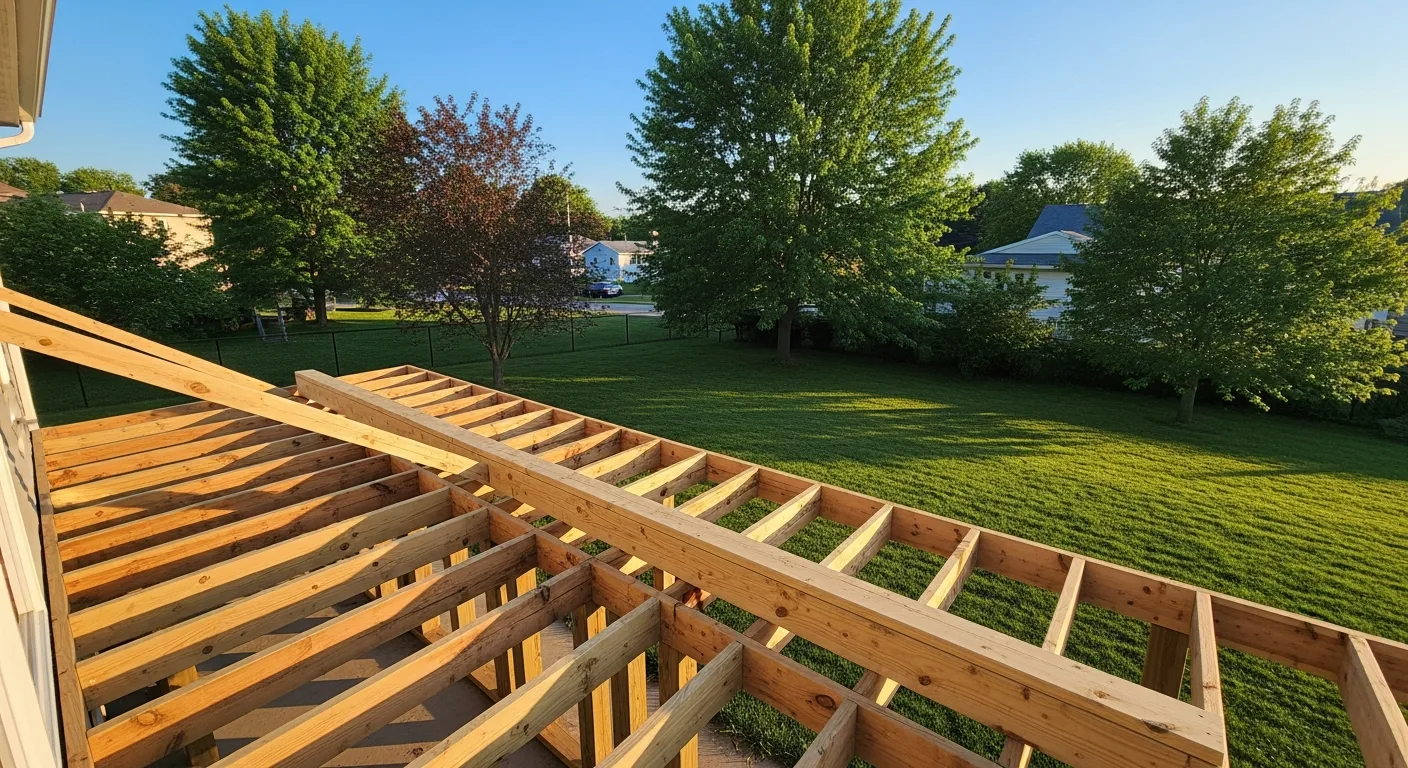
Deck construction seems simple until the building inspector shows up. Footings too shallow, ledger bolts in the wrong pattern, balusters spaced too wide, joist hangers missing. The list of code violations on deck projects is long, and the consequences range from a failed inspection to a structural collapse.
The International Residential Code (IRC) Section R507 covers prescriptive deck construction requirements. Most local jurisdictions adopt the IRC with amendments, so always verify your local code. This guide walks through the major code requirements and best practices for building a code-compliant wood deck.
Permits and Plans
Before you dig a single footing, figure out your permit requirements. Nearly every jurisdiction requires a permit for:
- Decks attached to a dwelling
- Decks elevated more than 30 inches above grade
- Decks exceeding a certain size (varies by jurisdiction)
The permit application typically requires a site plan showing the deck location relative to property lines and setbacks, a framing plan with member sizes and spacing, a cross-section showing the ledger connection and footing details, and a railing detail.
Some jurisdictions accept prescriptive plans based on the IRC span tables. Others require engineered drawings, especially for large or complex decks. Call your local building department before you start drawing.
Design Loads
Every structural member in a deck must be sized to carry the required loads. The IRC specifies:
Dead Load: 10 pounds per square foot (psf). This covers the weight of the deck materials themselves (framing, decking, railings).
Live Load: 40 psf for the deck surface. This represents the weight of people, furniture, grills, and other items on the deck. Some jurisdictions require 60 psf for areas that could be used for assembly or gathering.
Snow Load: Varies by location. In snow country, the ground snow load can exceed 50 psf, and the deck must be designed for the local requirement.
Lateral Load: The IRC requires decks to resist a lateral load of not less than the larger of the code-specified lateral load per the connection type or the prescriptive attachment requirements in R507.2.
All of these loads flow through the decking into joists, joists into beams, beams into posts, and posts into footings. Every connection in that chain must be strong enough to transfer the load.
Footings
Deck footings support the entire structure. Getting them wrong puts everything above them at risk.
Frost Depth
Footings must extend below the frost line. When soil freezes, it expands and can heave footings upward, which shifts the entire deck structure. Frost depths range from 12 inches in the southern United States to 48 inches or more in northern states and mountain regions.
Your local building department will tell you the required frost depth. Do not guess.
Footing Size
The footing must be large enough to spread the load over sufficient soil area. For most residential decks on average soil (bearing capacity of 1,500 psf), the IRC allows specific footing sizes based on the tributary area they support.
Common footing options:
- Poured concrete footings: The standard approach. Dig the hole, set a tube form (Sonotube or similar), and pour concrete. Minimum footing diameter for most residential decks is 12 inches, but larger decks or poor soil may require 16, 18, or 24-inch footings.
- Precast concrete piers: Allowed in some jurisdictions for ground-level decks. Not suitable for elevated decks in most codes.
- Helical piles: Screw-in steel piles that reach below the frost line without excavation. Increasingly popular and accepted by most codes when engineered.
Post Bases
The connection between the post and the footing must resist both uplift and lateral forces. A post sitting loose on a concrete pier is not a code-compliant connection.
Approved post bases include:
- Cast-in-place post base connectors: A metal bracket set into wet concrete with the post bolted on top.
- Retrofit post bases: Brackets anchored to cured concrete with expansion bolts or epoxy anchors.
All post base hardware must be rated for the required loads and approved for exterior use.
Posts
Deck posts transfer loads from the beam to the footings. The IRC prescriptive tables in R507.4 specify maximum post heights based on post size and the area of deck they support.
Key requirements:
- Minimum post size for most applications is 6x6 nominal (actual 5.5” x 5.5”). Some codes allow 4x4 posts for decks under a certain height, but 6x6 is the safer standard.
- Posts must be pressure-treated or naturally durable species when in contact with or close to the ground.
- Notching deck posts is not permitted per the IRC when posts are supporting beams. Notching reduces the effective cross-section and creates a stress concentration where the post is most likely to fail.
- Posts must be positively connected to beams with approved hardware (post caps or through-bolts). Toenailing is not acceptable.
Beams
Beams span between posts and support the joists. The IRC provides beam span tables in R507.5 based on species, grade, beam size, and the joist span (which determines the tributary area loading the beam).
Beam Construction
Built-up beams made from multiple 2x members (such as doubled or tripled 2x10s) are common in deck construction. These members must be fastened together with specific nailing patterns or bolts as specified in the code.
Solid sawn beams or engineered lumber (LVL, PSL) are also used, especially for longer spans. Engineered lumber requires protection from moisture when used outdoors.
Beam-to-Post Connection
Beams must be positively connected to posts. Acceptable methods:
- Beam sitting on top of post with post cap: The most common method. An approved metal post cap wraps around both the post and beam, transferring loads through the hardware.
- Beam bolted to the side of the post: Allowed by the IRC with specific bolt patterns and minimum member sizes. This method requires careful attention to the bolt layout to prevent splitting.
Beams should not bear on top of notched posts. This detail, while common in older construction, is no longer permitted in most codes because of the structural weakness created by the notch.
Joists
Joists are the repetitive framing members that span between the ledger (or beam) and the outer beam, supporting the decking.
Joist Sizing
The IRC provides joist span tables in R507.6 based on species, grade, size, and spacing. For example, a 2x8 No. 2 Southern Pine joist at 16 inches on center can span approximately 11 feet 1 inch.
Common joist sizes for residential decks:
- 2x6: Short spans up to about 8 feet
- 2x8: Spans up to about 11 feet
- 2x10: Spans up to about 14 feet
- 2x12: Spans up to about 17 feet
These numbers are approximate and vary by species, grade, and spacing. Always reference the span tables for your specific conditions.
Joist Hangers
Joists connecting to a ledger board or beam must use approved joist hangers. Face-nailed connections without hangers do not meet current code requirements.
Joist hanger requirements:
- Use hangers rated for the joist size and load
- Install all fasteners specified by the hanger manufacturer (every hole gets a nail or screw)
- Use only the fastener type and size specified (do not substitute drywall screws or roofing nails)
- Use hot-dip galvanized or stainless steel hangers for pressure-treated lumber to prevent corrosion
Cantilevers
Joists can cantilever past the beam to extend the deck without additional support. The IRC limits cantilevers to the lesser of one-fourth of the joist span or the maximum in the span tables for the specific joist size.
For example, if your joists span 12 feet from ledger to beam, the maximum cantilever would be 3 feet (one-fourth of 12 feet), assuming the span table allows it for that joist size.
Blocking and Bridging
Blocking (solid lumber pieces between joists) is required at the ledger, at beams, and at intervals specified by the code. Blocking prevents joists from twisting and helps transfer lateral loads through the framing system.
The Ledger Board: Most Critical Connection
The ledger board is the framing member that attaches the deck to the house. It is the most common point of failure in deck construction, and water damage at the ledger connection is the leading cause of deck collapses.
Fastener Requirements
The IRC requires the ledger to be connected to the house band joist (rim joist) with 1/2-inch lag screws or through-bolts in a specific pattern. Nails alone are never acceptable for ledger connections.
The bolt pattern from IRC Table R507.2.1 specifies:
- Two rows of bolts, staggered
- Bolt spacing varies from 13 inches to 36 inches on center depending on the joist span and deck width
- Minimum edge distance of 2 inches from the top and bottom of the ledger
- Minimum end distance of 2 inches
Flashing
Flashing is required at the ledger board to prevent water from entering the wall cavity behind the deck connection. Proper ledger flashing includes:
- Self-adhering membrane (flashing tape): Applied to the sheathing behind the ledger before the ledger is installed. This protects the wall sheathing.
- Metal Z-flashing or drip edge: Installed above the ledger and tucked behind the siding. This directs water running down the wall away from the top of the ledger.
- Spacers or standoffs: Some codes and best practices call for spacing the ledger away from the wall with washers or proprietary spacers to allow drainage behind the ledger.
A deck ledger without proper flashing will eventually rot, and when it fails, the deck separates from the house. This is not a theoretical concern. It happens every year.
Prohibited Ledger Attachments
The ledger must connect directly to the house’s floor framing (the band joist or floor joists). It cannot be attached to:
- Brick veneer or stone veneer
- Stucco or EIFS without verifying the underlying structure
- Cantilevered floor framing (without engineering)
- SIP panels (requires manufacturer-specific details)
If you cannot make a direct structural connection to the house framing, the deck must be freestanding with its own support posts and footings near the house.
Decking
The decking surface is what everyone sees, but the code requirements focus on structural capacity and fastening.
Joist Spacing for Decking
- 5/4 x 6 lumber decking: Maximum 16 inches on center joist spacing
- 2x6 lumber decking: Maximum 24 inches on center joist spacing
- Composite decking: Varies by manufacturer, typically 12 to 16 inches on center
Fastening
Decking must be fastened to each joist with two fasteners (screws or nails). Screws hold better and are preferred by most builders. Use corrosion-resistant fasteners rated for the decking material (stainless steel or coated screws for pressure-treated wood, manufacturer-specified fasteners for composites).
Hidden fastening systems are popular for composite decking and are acceptable when they meet the manufacturer’s load requirements.
Stairs
Deck stairs are heavily regulated because inconsistent stairs cause falls.
Rise and Run
- Maximum riser height: 7-3/4 inches
- Minimum tread depth: 10 inches
- Maximum variation between risers: 3/8 inch
- Minimum stair width: 36 inches
Consistency is the key requirement. A stairway where one riser is 1/2 inch different from the others creates a trip hazard. Measure carefully and cut all stringers from the same template.
Stair Stringers
Stringers are typically cut from 2x12 lumber with a minimum of 3-1/2 inches of remaining wood at the narrowest point (after the notches are cut). Stringer spacing depends on the tread material:
- 2x lumber treads: stringers at 36 inches on center maximum (3 stringers for a 36-inch-wide stair)
- Most codes require a center stringer for stairs wider than 36 inches
Stringers must bear on a concrete pad or footing at the bottom and connect to the deck framing with approved hardware at the top.
Stair Railings
Stairs with four or more risers require a graspable handrail on at least one side. The handrail must be:
- 34 to 38 inches high, measured vertically from the stair nosing
- Graspable with a cross-section of 1-1/4” to 2” diameter (round) or equivalent graspable shape
- Continuous for the full length of the stairs
- Returned to the wall or post at the top and bottom (no open ends that could catch clothing)
Railings and Guards
Guardrails (called “guards” in the IRC) are required on any deck surface more than 30 inches above grade.
Height
- Residential (IRC): Minimum 36 inches from the deck surface
- Commercial (IBC): Minimum 42 inches
Baluster Spacing
The 4-inch sphere rule: no opening in the guard system can allow a 4-inch sphere to pass through. This applies to:
- Spaces between balusters
- The gap between the bottom rail and the deck surface
- Any opening in the guard infill
Structural Requirements
Guards must resist a 200-pound concentrated load applied in any direction at the top of the rail. Guard posts must resist this load without the rail deflecting more than the limits specified in the code.
Post attachment is critical. Guard posts bolted through the rim joist with blocking behind the rim joist is the standard detail. Posts notched over the rim joist and lag-screwed from inside are also common and accepted.
Do not rely on toenails or small screws to hold guard posts. The forces involved when a person falls against a railing are significant.
Lumber and Material Requirements
Pressure-Treated Wood
All wood framing members within 6 inches of the ground or in contact with concrete must be pressure treated. In practice, most deck builders use pressure-treated lumber for all framing (posts, beams, joists, and ledger) because of the constant moisture exposure.
Current pressure treatment chemicals (Alkaline Copper Quaternary, or ACQ, and Copper Azole, or CA) are more corrosive to metal fasteners and hardware than the older CCA treatment. All fasteners and connectors must be rated for use with the specific treatment chemical. Hot-dip galvanized (minimum G185 coating) or stainless steel hardware is required.
Species and Grade
The IRC span tables list specific species and grades. Common choices for deck framing:
- Southern Pine No. 2: The most common deck framing lumber in the eastern and southern United States
- Douglas Fir-Larch No. 2: Common in the western United States
- Hem-Fir No. 2: Also common in western states
- SPF (Spruce-Pine-Fir) No. 2: Used in some regions but has shorter span capabilities
Inspection Process
Most jurisdictions require at least two inspections:
- Footing inspection: After holes are dug but before concrete is poured. The inspector verifies depth, diameter, and soil conditions.
- Framing inspection: After all framing is complete but before decking is installed. The inspector checks ledger attachment, joist hangers, beam-to-post connections, post-to-footing connections, and overall structural adequacy.
Some jurisdictions also require a final inspection after the decking, stairs, and railings are complete.
Having your project documentation organized makes the inspection process smoother. Inspectors appreciate seeing a plan set that matches what was built, along with product data sheets for hardware and materials. Projul’s document management features let you keep permits, plans, and product specs in one place and accessible from the job site.
Key Takeaways
Building a code-compliant deck requires attention to every connection in the load path:
- Size footings for your soil conditions and extend below the frost line
- Use approved post bases and post-to-beam connections
- Follow the IRC span tables for beams and joists
- Attach the ledger with the correct bolt pattern and proper flashing
- Meet railing height and baluster spacing requirements
- Use corrosion-resistant hardware rated for pressure-treated lumber
- Get inspections at each required stage
The code exists because decks fail. Ledger boards pull away from houses, railings give way under load, and footings heave in the winter. Following the prescriptive code requirements eliminates the most common failure modes and protects both your customers and your business.
For managing your deck projects from estimate through final inspection, check out Projul’s features or schedule a demo to see the platform in action.
Frequently Asked Questions
Do I need a permit to build a deck?
How deep do deck footings need to be?
What size beam do I need for a deck?
Can I attach a deck ledger to a cantilevered floor?
What is the maximum joist spacing for deck boards?
How tall does a deck railing need to be?
What is the 4-inch sphere rule for deck railings?
Do I need flashing behind a deck ledger?
Related Articles

BIM Clash Detection: How to Catch Conflicts Before They Cost You on the Jobsite
BIM Clash Detection: How to Catch Conflicts Before They Cost You on the Jobsite Every contractor has a story about the...
Read More →
Asphalt Paving and Compaction Guide: Mix Types, Laydown Temperatures, and Quality Testing
Asphalt paving looks straightforward from a distance. A truck dumps material, the paver lays it down, and rollers...
Read More →
Construction Jobsite Wi-Fi & Connectivity Guide: Setting Up Reliable Internet in the Field
A practical guide to getting reliable internet on construction job sites. Learn about cellular hotspots, mesh networks,...
Read More →