
Built-Up Roofing vs Single-Ply Membrane Guide for Contractors | Projul
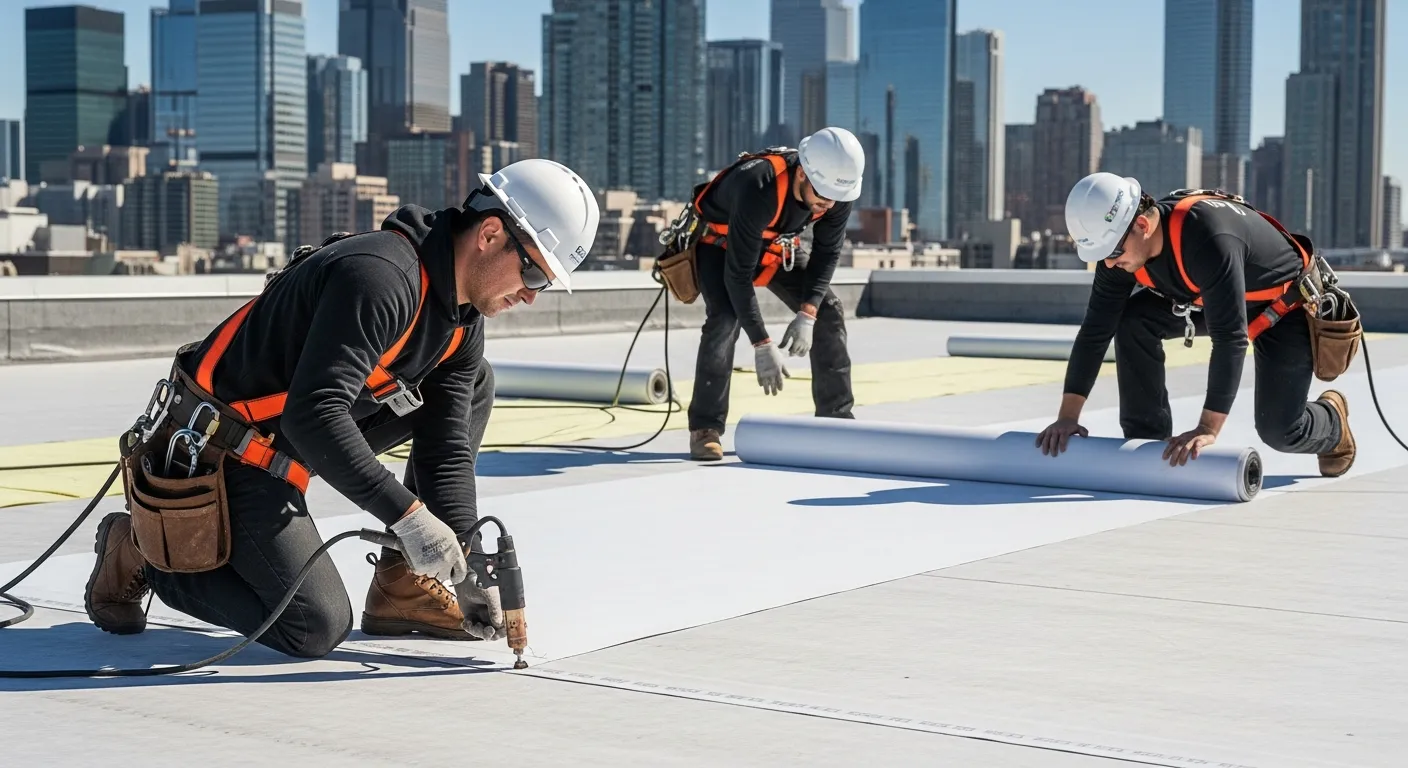
If you have been in commercial construction for any amount of time, you have dealt with flat roofs. And if you have dealt with flat roofs, you have probably had the conversation with a building owner about whether to go with built-up roofing or a single-ply membrane system. Both get the job done, but they get there in very different ways.
This guide walks through everything you need to know about these two systems so you can make smart recommendations, write tighter bids, and avoid the kind of callbacks that eat your margins alive.
What Is Built-Up Roofing and How Does It Work?
Built-up roofing, or BUR, is the old guard of flat roofing. It has been around for over 100 years, and there is a reason it has stuck around that long. The system works by layering alternating sheets of reinforcing fabric (called felts or ply sheets) with bitumen, which is either asphalt or coal tar. You build it up layer by layer, hence the name.
A typical BUR system has three to five plies. Each layer of felt gets mopped or torched with hot bitumen, and the whole assembly gets topped with a surfacing material. That top layer is usually gravel, a mineral cap sheet, or a reflective coating. The gravel serves double duty: it protects the membrane from UV degradation and adds ballast against wind uplift.
Here is what a standard BUR assembly looks like from bottom to top:
- Roof deck (steel, concrete, or wood)
- Vapor retarder (when needed based on climate)
- Insulation board (polyiso is the most common)
- Base sheet mechanically fastened or adhered to the insulation
- Three to four alternating layers of felt and bitumen
- Surfacing layer (gravel, cap sheet, or reflective coating)
The hot-applied method is the most traditional approach. Your crew heats asphalt in a kettle on the ground and pumps it up to the roof, where it gets mopped onto each ply sheet. This method creates excellent adhesion and waterproofing, but it also means working with extremely hot materials and managing fumes. Cold-applied BUR systems use adhesives instead of hot bitumen, which cuts down on safety concerns but can be more expensive in material costs.
One thing I always tell newer contractors: BUR is not a system you learn from watching a YouTube video. It takes experienced crews who know how to control bitumen temperature, manage felt alignment, and build consistent layers. If your crew does not have BUR experience, bring in a sub who does. The cost of a callback on a commercial roof will make your head spin. Keeping track of subcontractor performance and qualifications matters here, and having a system for managing subcontractor relationships makes a real difference when things go sideways.
Understanding Single-Ply Membrane Systems
Single-ply membranes are the newer players in flat roofing, and they have taken a massive share of the commercial market over the last 30 years. Instead of building up multiple layers, you install one sheet of synthetic material across the roof surface. The three main types are TPO, PVC, and EPDM.
TPO (Thermoplastic Polyolefin) is the most popular single-ply membrane in North America right now. It comes in white, which reflects sunlight and can help reduce cooling costs. TPO seams are heat-welded, creating a bond that is actually stronger than the membrane itself. It handles ponding water reasonably well and resists chemical exposure from rooftop HVAC units. Most TPO membranes run 45 to 80 mil thick.
PVC (Polyvinyl Chloride) has been around longer than TPO and has a strong track record, especially in restaurants and other buildings where grease and chemical exposure are concerns. PVC seams are also heat-welded. It costs a bit more than TPO but tends to hold up better in harsh chemical environments. PVC is also inherently fire-resistant, which matters on certain building types.
EPDM (Ethylene Propylene Diene Monomer) is the rubber roof that most people picture when they think of flat roofing. It comes in black, which absorbs heat, making it less popular in hot climates. EPDM seams are taped or glued rather than welded, which makes them the weakest point in the system. On the flip side, EPDM is the most forgiving membrane when it comes to building movement and temperature swings. It stretches without tearing.
Single-ply membranes can be installed three ways:
- Mechanically attached: Fastened to the deck with plates and screws, then the next sheet overlaps and gets welded or taped. This is the fastest method.
- Fully adhered: Glued directly to the insulation or substrate. This creates the smoothest appearance and best wind uplift resistance but takes longer.
- Ballasted: Laid loose over the roof and held down with river rock or pavers. Cheapest to install but adds significant weight.
When you are putting together an estimate for a single-ply job, accurate material takeoffs are critical. A 10% error on membrane quantity for a 50,000 square foot roof is real money. Using construction estimating best practices will keep your bids tight and your profit margins healthy.
Cost Comparison: BUR vs Single-Ply Membrane
Let us talk numbers, because that is what your clients care about and what determines whether you make money on a job.
Built-up roofing typically runs $5.50 to $8.50 per square foot installed, depending on the number of plies, the surfacing material, and your local labor market. A four-ply gravel BUR system on a 20,000 square foot building might come in around $130,000 to $170,000 all in. The big cost drivers are labor (BUR is labor-intensive) and equipment (kettles, pumps, and cranes for gravel).
Single-ply membrane generally costs $4.00 to $7.50 per square foot installed. TPO sits at the lower end, PVC in the middle, and EPDM varies depending on thickness and attachment method. That same 20,000 square foot building with a mechanically attached TPO system might run $80,000 to $120,000.
But here is where it gets interesting. When you factor in lifecycle costs, the gap narrows or sometimes flips entirely. BUR roofs routinely last 25 to 30 years with minimal maintenance. Some coal tar BUR roofs have lasted 40 years or more. Single-ply membranes, particularly TPO, are still proving their long-term track record. Early TPO formulations had issues with seam failures and membrane shrinkage, though the newer products have improved significantly.
Maintenance costs also differ. Patching a BUR roof usually means applying more bitumen and fabric to the damaged area. It is straightforward and any roofing crew can handle it. Repairing a single-ply membrane requires matching the exact material and using the correct adhesive or welding equipment. EPDM repairs are simple with peel-and-stick patches, but TPO and PVC repairs need a heat welder.
When you are running these numbers for a bid, tracking your actual costs against estimates on past projects helps you sharpen future pricing. A solid job costing system makes it easy to see where you made money and where you left it on the table.
Tear-off and disposal is another factor. Removing an old BUR system is heavy, messy work. Gravel-surfaced BUR generates a lot of weight in dumpsters. Single-ply tear-off is faster and lighter. If your bid includes tear-off, price it carefully because dumpster costs and labor for a BUR removal can surprise you if you have not done it before.
Installation Considerations and Crew Requirements
The installation process is where these two systems really diverge, and it is where a lot of contractors either make their money or lose it.
BUR installation requires a larger crew and more specialized equipment. You need a kettle operator, pump operator, and multiple workers on the roof handling felts and mops. A typical BUR crew runs six to ten people. The kettle has to be monitored constantly to keep bitumen within the right temperature range (usually 400 to 450 degrees Fahrenheit for asphalt). Too hot and you degrade the material. Too cool and you get poor adhesion.
Weather plays a bigger role with BUR than you might expect. You cannot apply hot bitumen in rain, and cold temperatures slow everything down. Most manufacturers require ambient temperatures above 40 degrees Fahrenheit for application. Wind is also a concern because it can cool the bitumen before it bonds properly.
Curious what other contractors think? Check out Projul reviews from real users.
Safety is a serious consideration with hot-applied BUR. Burns are the most common injury, followed by fume inhalation. Your crew needs proper PPE including heat-resistant gloves, long sleeves, face shields near the kettle, and respiratory protection when working around fumes. Having a clear safety program in place is not optional on these jobs.
Single-ply installation typically needs a smaller crew of three to five people. Mechanically attached systems are the fastest to install. A good crew can lay 150 to 200 squares per day (a square is 100 square feet) on a straightforward job. Fully adhered systems are slower, maybe 80 to 120 squares per day, because of adhesive application and rolling.
Heat welding is the critical skill for TPO and PVC installation. The welding machine has to run at the right temperature and speed for the specific membrane thickness and ambient conditions. Most manufacturers require certified welders on their projects, and they will void the warranty if an uncertified installer does the work.
For both systems, scheduling your crew efficiently is half the battle on larger commercial jobs. Roofing is weather-dependent, and delays cascade fast when you have a building owner waiting to move tenants in. A good crew scheduling process keeps your labor coordinated and your timeline realistic.
Roof penetrations (pipes, drains, HVAC curbs, exhaust fans) are where most leaks originate regardless of the system. BUR handles penetrations by building up extra plies around the base of each penetration. Single-ply systems use prefabricated boots or field-fabricated flashings welded or adhered to the membrane. Either way, your detail work at penetrations and perimeter edges is what separates a roof that lasts from one that leaks in the first year.
Choosing the Right System for Your Project
Picking between BUR and single-ply is not about which system is better overall. It is about which system fits the specific project in front of you. Here are the factors I run through on every commercial roofing bid.
Building use and rooftop traffic. If the roof will see regular foot traffic for HVAC maintenance, antenna service, or window cleaning, BUR is more forgiving. The gravel surface protects the membrane from punctures and scuffing. If foot traffic will be minimal, single-ply works fine, though you should still install walkway pads at access points and around equipment.
Climate and energy goals. In hot climates, white TPO or PVC membranes reduce cooling costs by reflecting solar radiation. This matters to building owners watching their energy bills. In colder climates, the heat absorption of black EPDM can actually be beneficial. BUR with a reflective coating can split the difference, giving you the durability of a multi-ply system with some reflective benefit.
Budget constraints. If the building owner is focused on first cost and wants the cheapest option that still performs, mechanically attached TPO is usually the answer. If they are thinking long-term and want the lowest cost per year of service, BUR or PVC often wins that math.
Structural capacity. BUR with gravel surfacing adds 10 to 15 pounds per square foot. On older buildings or lightweight steel structures, that load matters. Single-ply systems add minimal weight, making them the default choice when structural capacity is a concern. Always check with the structural engineer before specifying a ballasted or gravel-surfaced system on an existing building.
Local code requirements. Some jurisdictions have specific fire rating requirements that favor certain systems. FM Global and UL ratings vary by assembly, and your local authority having jurisdiction may require specific assemblies for wind uplift or fire resistance. Check your local codes early in the bid process so you do not price one system and then find out you need another.
Your crew’s experience. This one matters more than most contractors want to admit. If your crew has installed 200 TPO roofs and zero BUR roofs, you should not bid a BUR job and figure it out on the fly. Stick with what you know or sub out the work to a crew that specializes in the system you are specifying.
When you are juggling multiple roofing bids at once, keeping track of which projects need which systems, which crews are available, and which materials need to be ordered gets complicated fast. A project management system built for contractors keeps all of that organized so nothing falls through the cracks.
Maintenance, Warranties, and Long-Term Performance
A roof is only as good as the maintenance program behind it. Both BUR and single-ply systems need regular attention to hit their expected lifespan, and the maintenance approach differs for each.
BUR maintenance is relatively straightforward. Annual inspections should look for cracks in the bitumen surface, blistering between plies, and areas where gravel has shifted or washed away. Blisters are common in BUR and do not always mean failure. Small blisters with no moisture underneath can be left alone. Large blisters or those with moisture inside need to be cut open, dried out, and patched with new felt and bitumen.
Gravel-surfaced BUR roofs can hide damage, which is both a benefit and a drawback. The gravel protects the membrane but makes it harder to spot problems during an inspection. Flood testing (temporarily damming the drains and filling the roof with a few inches of water) is one of the best ways to find leaks on a BUR roof, but it requires confirming the structure can handle the temporary water load.
Single-ply maintenance focuses on seam integrity and membrane condition. Heat-welded seams (TPO and PVC) rarely fail if they were done correctly at installation. Taped and glued seams (EPDM) are more prone to separation over time, especially at corners and around penetrations. UV degradation is the main enemy of single-ply membranes. PVC and TPO hold up well, but EPDM can become brittle after 15 to 20 years of sun exposure.
Ponding water is a concern for both systems but particularly for single-ply. Standing water accelerates UV degradation and can void some manufacturers’ warranties. If a roof has chronic ponding issues, adding tapered insulation to promote drainage is usually the right move. Price it into the original installation if you know the deck is not sloped.
Warranties vary by manufacturer and system, but here is the general landscape:
- BUR: Manufacturer warranties typically run 10 to 20 years. Because BUR uses materials from multiple manufacturers (insulation, felts, bitumen, surfacing), getting a single-source warranty can be tricky. Some manufacturers offer system warranties when you use all of their components.
- TPO/PVC: Manufacturer warranties range from 15 to 30 years. These are usually easier to obtain because one manufacturer supplies the membrane, flashings, and adhesives.
- EPDM: Warranties of 15 to 30 years are standard from major manufacturers.
The difference between a material-only warranty and a full system warranty (including labor for repairs) is significant. Full system warranties cost more upfront but protect the building owner from out-of-pocket repair costs. As the contractor, you want to know exactly what the warranty covers before you make promises to your client.
Tracking warranty information, inspection schedules, and maintenance records across multiple roofing projects is the kind of thing that gets lost in filing cabinets and email inboxes. Keeping this information in your project management software means you can pull up a roof’s history in seconds when a client calls about a leak three years after installation.
Long-term performance trends in the industry are worth noting. TPO has improved dramatically since its early days in the 1990s, when seam failures and formulation issues gave it a rocky start. Modern TPO from reputable manufacturers is a solid product. PVC has the longest track record among single-ply membranes, with some installations still performing after 30 plus years. EPDM remains the simplest to repair but its black color and taped seams make it less popular for new construction. BUR continues to be specified on projects where longevity and durability outweigh speed of installation.
Want to put this into practice? Book a demo with Projul and see the difference.
The commercial roofing market is shifting toward single-ply systems overall, but BUR is not going anywhere. Smart contractors keep both options in their toolbox and recommend the right system based on the project, not based on what is easiest or most familiar. That kind of approach builds trust with building owners and repeat business that keeps your pipeline full. And when your pipeline gets busy, having the right tools to manage your budget across all those projects is what keeps you profitable.
Frequently Asked Questions
What is the difference between built-up roofing and single-ply membrane?
How long does a built-up roof last compared to single-ply?
Which is cheaper to install, BUR or single-ply membrane?
Can you install single-ply membrane over an existing built-up roof?
What roofing system is best for a flat commercial building?
Related Articles
Construction Loading Dock Design and Installation Guide
A practical guide for contractors on loading dock design and installation, covering dock types, structural specs,...
Read More →
Parking Garage Waterproofing and Deck Coating: A Contractor's Complete Guide
Parking garage waterproofing and deck coating work is specialized, high-stakes, and easy to get wrong. This guide...
Read More →
Construction Plaster and Specialty Wall Finishes Guide
Plaster and specialty wall finishes are making a serious comeback in both residential and commercial construction. This...
Read More →