
Construction Mechanical Piping and Process Piping Guide | Projul
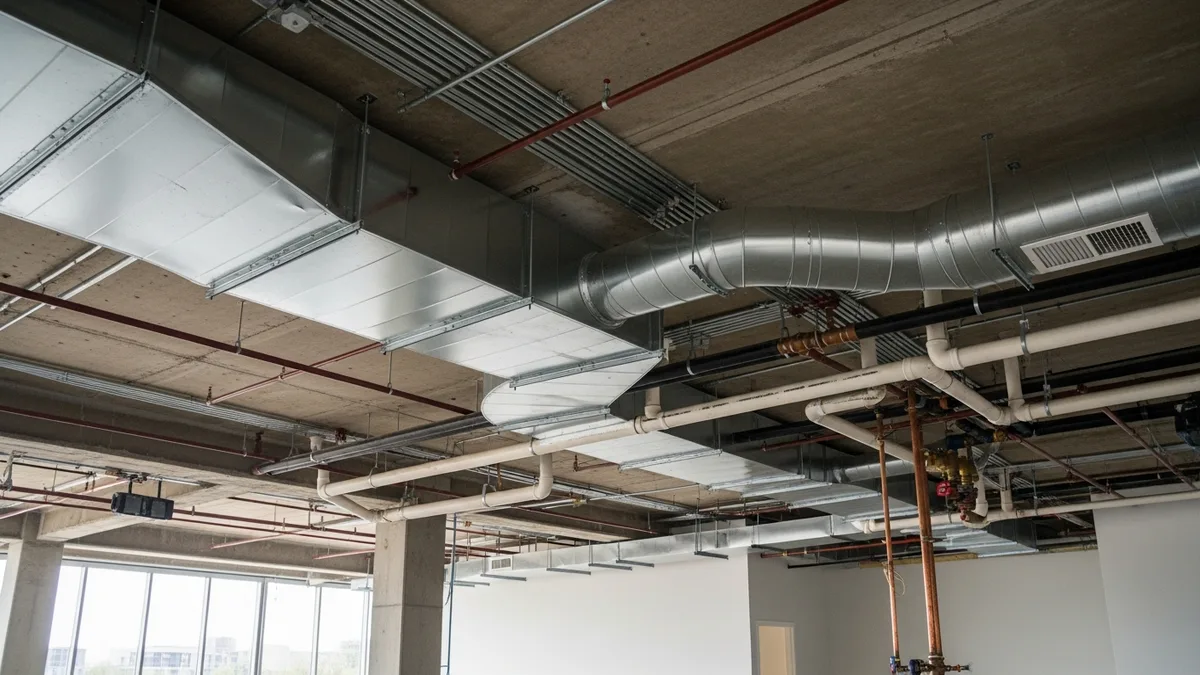
Mechanical piping and process piping are two different animals, even though they both involve welding pipe and running hangers. If you have been in the piping trade for any amount of time, you already know the distinction matters. It matters for bidding, it matters for scheduling, and it definitely matters when the inspector shows up.
This guide is written for piping contractors and the general contractors who hire them. We will cover what separates mechanical piping from process piping, the codes and standards you need to know, how to bid this work without leaving money on the table, and how to keep piping projects on schedule when every other trade is fighting for the same overhead space.
What Is Mechanical Piping?
Mechanical piping refers to the piping systems that serve a building’s mechanical systems. Think HVAC hydronic loops, chilled water lines, steam distribution, domestic water, sanitary waste, storm drain, and fire protection sprinkler systems. If it keeps a building comfortable, safe, or code-compliant from a facilities standpoint, it probably falls under mechanical piping.
The work itself ranges from copper and PVC in smaller commercial buildings to large-bore welded steel in hospitals, data centers, and high-rises. Mechanical piping contractors typically work under codes like ASME B31.9 (Building Services Piping), the International Mechanical Code, and NFPA 13 for fire protection.
Here is what makes mechanical piping distinct:
- Building-centric scope. The piping serves the building and its occupants. You are moving water, steam, or refrigerant to make systems work.
- Moderate pressures and temperatures. Most mechanical systems operate well below the extreme conditions you see in process work. Chilled water runs around 42-45°F. Low-pressure steam is typically under 15 PSI.
- High coordination demand. Mechanical piping shares ceiling space with ductwork, electrical conduit, cable trays, and structural elements. If you have ever tried to run an 8-inch chilled water main through a corridor that already has 30 inches of ductwork in it, you understand the coordination challenge.
- Repetitive layouts. Many mechanical systems follow predictable patterns, especially in multi-story buildings where risers and branch lines repeat floor to floor.
For contractors running mechanical piping crews, the biggest daily challenge is usually coordination, not complexity. You need to know exactly where your hangers land, how your pipe routes interact with other trades, and when your insulator can follow behind your fitters. Good construction scheduling practices make or break mechanical piping work.
What Is Process Piping?
Process piping is a completely different world. These systems carry chemicals, petroleum products, industrial gases, slurries, acids, and other substances that are part of a manufacturing or production process. You find process piping in refineries, chemical plants, pharmaceutical facilities, food and beverage processing, power generation, and water treatment plants.
The governing code for process piping in the U.S. is ASME B31.3, and it is considerably more demanding than mechanical piping codes. Every weld gets documented. Every material certificate gets filed. NDE (non-destructive examination) requirements can include radiography, ultrasonic testing, liquid penetrant, and magnetic particle inspection depending on the service classification.
Key characteristics of process piping:
- Hazardous or critical service. The fluids inside these pipes can be toxic, flammable, corrosive, or under extreme pressure and temperature. A failure is not just a leak; it can be a safety incident.
- Exotic materials. While mechanical piping mostly uses carbon steel, copper, and PVC, process piping regularly calls for stainless steel (304, 316, duplex), chrome-moly alloys, Inconel, Hastelloy, and lined piping systems. Material costs can be five to ten times higher per foot.
- Stringent weld quality. Welders on process piping jobs need current ASME Section IX qualifications. Many projects require 100% radiography on butt welds. That means every single weld gets X-rayed before the system can be tested.
- Detailed documentation. Weld maps, material traceability, NDE reports, pressure test packages, and turnover documentation are all standard requirements. If you cannot produce the paperwork, the pipe might as well not exist.
Process piping contractors carry a different kind of risk than mechanical contractors. The materials cost more, the labor is more specialized, the testing is more expensive, and the liability is higher. That risk needs to show up in your pricing, which means your estimating process has to be airtight.
Codes, Standards, and Compliance
One of the fastest ways to get burned on a piping project is to misunderstand which code applies. Here is a quick reference:
ASME B31.1 — Power Piping. Covers piping in power plants, including steam, water, oil, gas, and air systems associated with power generation.
ASME B31.3 — Process Piping. The big one for industrial work. Covers piping in petroleum refineries, chemical plants, pharmaceutical facilities, textile plants, paper plants, semiconductor facilities, and related industries.
ASME B31.5 — Refrigeration Piping. Covers piping for refrigerants and secondary coolants.
ASME B31.9 — Building Services Piping. Covers piping typically found in commercial and institutional buildings, including HVAC, plumbing, and compressed air systems operating within defined pressure and temperature limits.
NFPA 13 — Sprinkler Systems. Not an ASME code, but the primary standard for fire sprinkler system installation.
ASME Section IX — Welding Qualifications. Not a piping code itself, but the code that governs welder and welding procedure qualifications. Required across most ASME B31 work.
Why does this matter for your bottom line? Because each code carries different requirements for materials, joining methods, inspection, and testing. Bidding a process piping job with mechanical piping assumptions will either lose you money or lose you the job. The inspection and NDE costs alone on a B31.3 project can run 8-12% of the total piping budget. Miss that in your estimate and your margins disappear.
Contractors across the country trust Projul to run their businesses. Read their reviews.
If you want to track those costs accurately as the job progresses, you need a system that breaks expenses down by cost code and compares actual spend to your budget in real time. We have a full breakdown of construction cost codes that shows how to structure this.
How to Estimate Piping Work
Piping estimation is part science, part experience, and part knowing which questions to ask before you put numbers on paper. Here is the approach that works for most piping contractors:
1. Start with the drawings. Isometric drawings (isos) are the backbone of piping takeoffs. Each iso shows a single pipe run with all fittings, valves, and dimensions. If you are working from plan and elevation views only, you will need to create your own isos or work from a 3D model.
2. Do a detailed material takeoff. Count every fitting, flange, valve, gasket, bolt set, and hanger. For process piping, every component needs to match the material specification on the line list. A carbon steel flange on a stainless line is not just wrong; it is a rejection and a rework cost.
3. Calculate weld counts. This is where piping estimation gets specific. Each butt weld takes a certain amount of labor depending on pipe diameter, wall thickness, material, and position. A 2-inch schedule 40 carbon steel butt weld in the shop is a completely different animal than a 10-inch schedule 80 stainless weld overhead in the field. Track your weld counts by diameter inch (the sum of all weld diameters on the job) as a key metric.
4. Factor in NDE and testing. On mechanical piping, you might hydro test the system and call it good. On process piping, you could be looking at radiography on every butt weld, hydrostatic testing to 1.5 times design pressure, and leak testing after that. These are real costs that need real line items.
5. Do not forget supports and hangers. Pipe does not float. Hangers, supports, guides, anchors, and spring cans add material and labor to every run. On large-bore high-temperature piping, engineered supports can be a significant portion of the total installed cost.
6. Account for insulation. Most mechanical piping gets insulated for energy efficiency or condensation control. Process piping insulation requirements vary by service, but personnel protection insulation is common on any line running above 140°F.
7. Build in your risk. Process piping carries more risk than mechanical. Rework costs are higher because of the materials and testing involved. Your contingency should reflect that reality.
Using construction estimating software that lets you build templates for common piping assemblies saves a huge amount of time on repeat project types. Once you have a template for, say, a 4-inch schedule 40 stainless steel line with standard fittings and 100% RT, you can reuse it across projects and just adjust quantities.
For keeping your estimates accurate against real-world costs, read our guide on construction estimating accuracy.
Scheduling and Coordinating Piping Work
Piping is rarely the first trade on site, but it is almost always on the critical path. A delay in piping means a delay in insulation, which means a delay in closing ceilings, which means a delay in finishes. Everything stacks.
Here is how experienced piping contractors approach scheduling:
Underground and below-slab work comes first. Sanitary, storm, and any below-grade process piping needs to be installed and tested before the slab is poured. Miss this window and you are looking at expensive core drilling or rerouting.
Coordinate early with BIM. On any project with significant MEP density, 3D coordination through BIM is not optional. Piping contractors who show up to coordination meetings with their own 3D models get better routing and fewer conflicts. Contractors who wait for the GC to figure it out get whatever space is left.
Prefabricate what you can. Shop fabrication is faster, cheaper, and higher quality than field fabrication for most piping assemblies. Spool pieces, headers, and manifolds that are welded and tested in the shop arrive on site ready to install. This is especially true for process piping where weld quality requirements make field welding slower and more expensive.
Sequence your work by system priority. Not all piping systems have the same urgency. Fire protection mains often need to be in place for temporary sprinkler protection before other work begins. Chilled water and heating hot water lines need to be ready for equipment startup and commissioning. Process piping timelines depend on the overall plant schedule and when individual systems need to be turned over for commissioning.
Plan for testing and inspection holds. Pressure testing requires full systems to be complete, supported, and accessible. You cannot test a system that is half-installed or buried behind drywall. Build testing milestones into your schedule and make sure every trade knows when piping needs to be clear for inspection.
Good piping scheduling requires the same discipline as any other construction crew scheduling work, just with more coordination points and tighter tolerances.
Managing Piping Projects With Software
Running a piping operation on spreadsheets and paper timesheets worked fine when jobs were simpler and margins were fatter. That is not the world we live in anymore. Between material price swings, labor shortages, and the documentation demands of process piping work, you need systems that keep up.
Here is what piping contractors should look for in project management software:
Job costing by cost code. You need to see your labor, material, and subcontractor costs broken down by system, area, or pipe spec. When you know your 6-inch stainless is running 15% over budget at the 40% completion mark, you can adjust before the job is finished. If you are tracking costs in a spreadsheet that gets updated once a month, you are finding out too late.
Our guide on construction job costing covers this in detail.
Time tracking with location or task coding. Your fitters might work on three different systems in a single day. You need time tracking that captures where those hours went, not just that they showed up. Mobile time tracking lets your foreman code hours to specific work areas or pipe specs right from the field.
Document management. Process piping generates a mountain of paperwork: weld maps, NDE reports, material certs, test reports, daily logs, and RFIs. If these documents live in a filing cabinet in a trailer, good luck finding the weld report for spool W-247 when the owner’s inspector asks for it during turnover. Digital document management with search and tagging is not a luxury on piping projects; it is a necessity.
Scheduling with dependencies. Piping schedules are full of dependencies. You cannot insulate before you test. You cannot test before you complete the system. You cannot complete the system before you get the specialty valves that are 16 weeks out. Your scheduling tool needs to handle linked tasks and show the impact of delays on downstream work.
Change order tracking. Piping projects generate change orders. Routing changes, spec changes, added tie-ins, and field-routed lines all create scope changes that need to be documented and priced. If you are not capturing these in real time, you are leaving money on site.
Projul gives piping contractors the tools to manage all of this in one place, from the initial estimate through final invoicing. The estimating module handles detailed line-item takeoffs, the scheduling tools show your crew exactly what is happening each day, and the job costing dashboard tells you where you stand financially at any point in the project. You do not need separate software for each function, and you do not need to pay per user, so your entire crew from the office to the field can stay connected.
Whether you are running a mechanical piping crew on commercial construction or managing process piping work in an industrial plant, having the right software in place keeps your projects organized, your costs visible, and your documentation complete. If you are still figuring out which software fits your operation, check out our comparison of the best construction project management software to see how the options stack up.
Book a quick demo to see how Projul handles this for real contractors.
Piping work is demanding, detailed, and unforgiving when things go wrong. But contractors who understand the codes, estimate carefully, schedule realistically, and track their costs will keep winning work and holding onto their margins. That is the whole point.
Frequently Asked Questions
What is the difference between mechanical piping and process piping?
What code governs process piping in the United States?
Do I need special certifications to weld process pipe?
How do I estimate mechanical piping work accurately?
Can one contractor handle both mechanical and process piping?
Related Articles
Construction Apprenticeship vs Trade School: Which Path Is Better?
Apprenticeships and trade schools both lead to careers in the trades, but they take very different routes to get there....
Read More →
Owner-Builder Construction: What You Need to Know Before Acting as Your Own GC
Being your own general contractor sounds like a great way to save money, but the reality involves permits, insurance,...
Read More →
Construction Concrete Basics: Types, Mixes, and Placement for Contractors
Concrete is one of the most common materials on any job site, but getting it wrong is expensive. This guide covers the...
Read More →