
Free Roofing Estimate Templates (2026) - Download Now
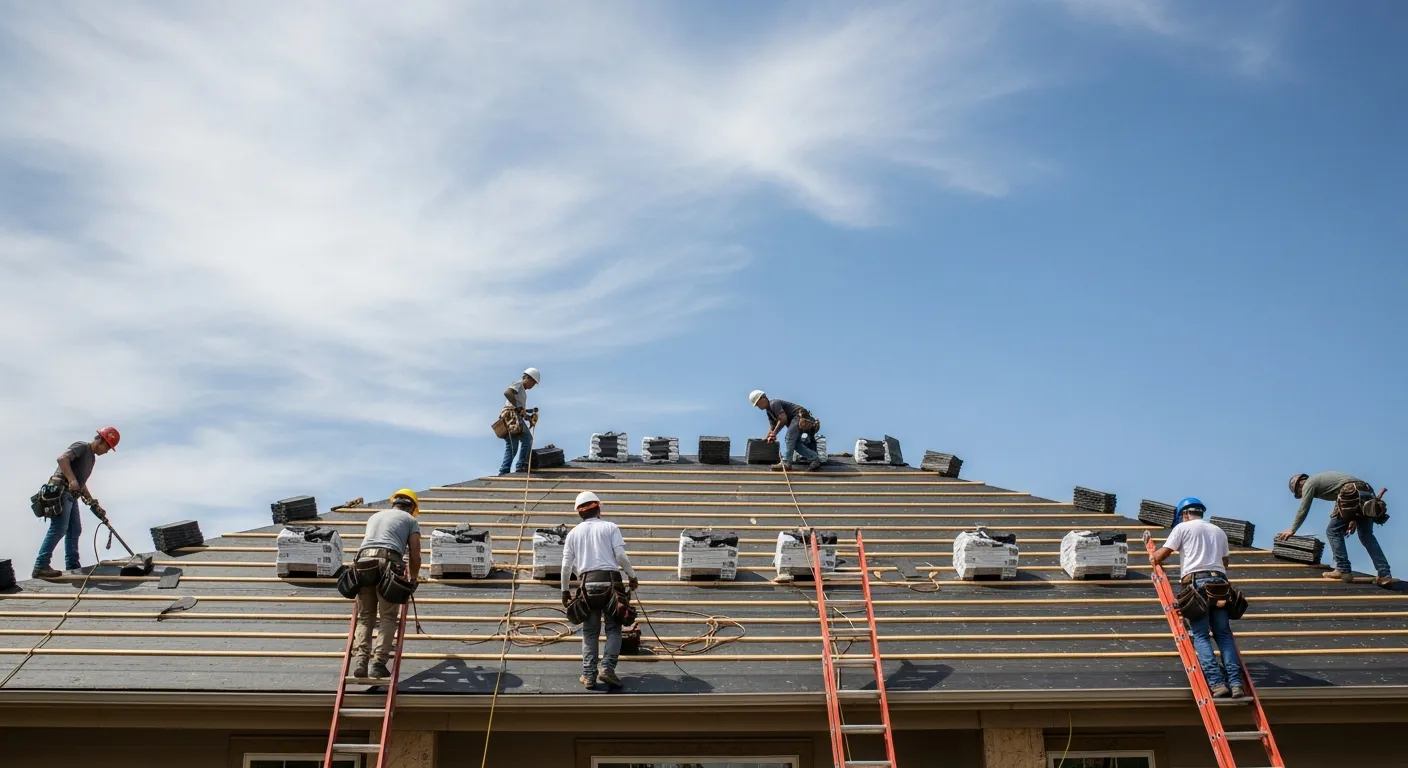
A good roofing estimate wins jobs. A bad one loses money. Either way, the estimate sets the tone for the entire project.
The problem most roofers face is not a lack of skill on the roof. It is the time it takes to put together a professional estimate once they climb back down. You take measurements, note the existing material, check for damage, drive back to the office, and then spend an hour or more fighting with a spreadsheet. By the time you send the estimate, the homeowner already has a quote from your competitor.
These three templates fix that problem. Each one includes realistic line items, material costs, labor rates, and markup formulas you can adjust for your market. Copy them, customize them, and start sending better estimates today.
📥 Get Your Free Estimate Templates
Download Projul’s free construction estimate templates — built by contractors, ready to customize. Create professional estimates in minutes and win more jobs.
How to Use These Templates
Each template below is organized into sections: materials, labor, equipment, overhead, and profit. Here is how to get the most out of them:
- Measure the roof and calculate total squares (length x width / 100 for each plane, plus waste factor).
- Adjust unit costs to match your local supplier pricing and labor rates.
- Update quantities based on the specific job.
- Apply your overhead and profit percentages to the subtotal.
- Add notes for the homeowner explaining scope, timeline, and warranty.
The unit costs shown are mid-range estimates for the U.S. market in 2026. Your area may run higher or lower. Always verify pricing with your supplier before sending a live estimate.
Template 1: Residential Roof Replacement Estimate
This template covers a standard 30-square residential re-roof (approximately 3,000 sq ft) with architectural shingles. Adjust quantities and pricing for your specific job.
Materials
| Line Item | Quantity | Unit | Unit Cost | Total |
|---|---|---|---|---|
| Architectural shingles (30-yr) | 33 | squares | $130.00 | $4,290.00 |
| Synthetic underlayment | 4 | rolls | $65.00 | $260.00 |
| Ice and water shield | 4 | rolls | $120.00 | $480.00 |
| Drip edge (aluminum) | 200 | lin ft | $2.00 | $400.00 |
| Ridge vent | 40 | lin ft | $4.50 | $180.00 |
| Ridge cap shingles | 3 | bundles | $55.00 | $165.00 |
| Step flashing | 50 | pieces | $1.50 | $75.00 |
| Pipe boot flashings | 3 | each | $15.00 | $45.00 |
| Roofing nails (coil) | 6 | boxes | $45.00 | $270.00 |
| OSB decking (replacement allowance) | 8 | sheets | $35.00 | $280.00 |
| Materials Subtotal | $6,445.00 |
Labor
| Task | Quantity | Unit | Unit Cost | Total |
|---|---|---|---|---|
| Tear-off (single layer) | 30 | squares | $25.00 | $750.00 |
| Install underlayment and ice shield | 30 | squares | $10.00 | $300.00 |
| Install shingles | 30 | squares | $45.00 | $1,350.00 |
| Install flashing and metalwork | 1 | lot | $400.00 | $400.00 |
| Install ridge vent and cap | 40 | lin ft | $3.00 | $120.00 |
| Decking repair labor | 8 | sheets | $20.00 | $160.00 |
| Cleanup and haul-off | 1 | lot | $300.00 | $300.00 |
| Labor Subtotal | $3,380.00 |
Equipment and Other Costs
| Item | Quantity | Unit | Unit Cost | Total |
|---|---|---|---|---|
| Dumpster rental (20-yard) | 1 | each | $450.00 | $450.00 |
| Permit fee | 1 | each | $250.00 | $250.00 |
| Material delivery fee | 1 | each | $125.00 | $125.00 |
| Equipment Subtotal | $825.00 |
Summary
| Amount | |
|---|---|
| Materials | $6,445.00 |
| Labor | $3,380.00 |
| Equipment and other | $825.00 |
| Direct Cost Subtotal | $10,650.00 |
| Overhead (15%) | $1,597.50 |
| Profit (12%) | $1,469.70 |
| Total Estimate | $13,717.20 |
Tips for This Template
- The 33 squares of shingles includes a 10% waste factor on a 30-square roof. Bump to 15% for complex roofs with lots of hips and valleys.
- The decking replacement allowance covers 8 sheets of OSB. Add a note on the estimate that says: “Additional decking repairs billed at $35/sheet material plus $20/sheet labor if needed once tear-off is complete.”
- Always list the shingle manufacturer and product name. Homeowners compare estimates, and specifics build trust.
- Include your workmanship warranty period alongside the manufacturer’s material warranty.
Template 2: Roof Repair Estimate
This template covers common repair jobs: leak fixes, damaged shingle replacement, and flashing repairs. It is designed for smaller scopes where speed matters.
Materials
| Line Item | Quantity | Unit | Unit Cost | Total |
|---|---|---|---|---|
| Architectural shingles (matching) | 3 | bundles | $40.00 | $120.00 |
| Synthetic underlayment (partial roll) | 1 | roll | $65.00 | $65.00 |
| Step flashing | 12 | pieces | $1.50 | $18.00 |
| Pipe boot flashing | 1 | each | $15.00 | $15.00 |
| Roofing sealant/caulk | 2 | tubes | $8.00 | $16.00 |
| OSB decking (if needed) | 2 | sheets | $35.00 | $70.00 |
| Roofing nails | 1 | box | $45.00 | $45.00 |
| Materials Subtotal | $349.00 |
Labor
| Task | Quantity | Unit | Unit Cost | Total |
|---|---|---|---|---|
| Diagnose leak / inspect damage | 1 | hour | $85.00 | $85.00 |
| Remove damaged shingles | 1 | hour | $85.00 | $85.00 |
| Replace underlayment and decking | 1.5 | hours | $85.00 | $127.50 |
| Install replacement shingles | 1.5 | hours | $85.00 | $127.50 |
| Re-flash penetrations or walls | 1 | hour | $85.00 | $85.00 |
| Cleanup | 0.5 | hours | $85.00 | $42.50 |
| Labor Subtotal | $552.50 |
Equipment and Other Costs
| Item | Quantity | Unit | Unit Cost | Total |
|---|---|---|---|---|
| Truck/travel charge | 1 | each | $75.00 | $75.00 |
| Debris removal | 1 | each | $50.00 | $50.00 |
| Equipment Subtotal | $125.00 |
Summary
| Amount | |
|---|---|
| Materials | $349.00 |
| Labor | $552.50 |
| Equipment and other | $125.00 |
| Direct Cost Subtotal | $1,026.50 |
| Overhead (15%) | $153.98 |
| Profit (15%) | $177.07 |
| Total Estimate | $1,357.55 |
Tips for This Template
- Repair estimates benefit from a higher profit margin (15% vs 12%) because the fixed costs of travel, setup, and cleanup eat into smaller jobs more.
- Always include a diagnostic/inspection line item. Your expertise in finding the leak source has real value. Do not give it away for free.
- Specify the repair area clearly: “Replace approximately 50 sq ft of shingles on south-facing slope above garage.” This protects you if the homeowner expects you to fix the entire roof for a repair price.
- If the repair reveals bigger problems (widespread rot, failed underlayment), have a change order process ready. Take a photo, price the additional work, and get approval before continuing.
Template 3: Commercial Roofing Estimate
This template covers a 100-square (10,000 sq ft) commercial flat roof with TPO membrane. Commercial jobs require more detail on equipment, phasing, and code compliance.
Materials
| Line Item | Quantity | Unit | Unit Cost | Total |
|---|---|---|---|---|
| 60-mil TPO membrane | 110 | squares | $95.00 | $10,450.00 |
| Polyiso insulation (3-inch) | 10,000 | sq ft | $1.25 | $12,500.00 |
| Cover board (1/2-inch) | 10,000 | sq ft | $0.55 | $5,500.00 |
| Membrane adhesive | 50 | gallons | $32.00 | $1,600.00 |
| TPO edge metal/termination bar | 400 | lin ft | $3.50 | $1,400.00 |
| Pipe boots and penetration flashings | 12 | each | $45.00 | $540.00 |
| Drain assemblies | 4 | each | $175.00 | $700.00 |
| Fasteners and plates | 1 | lot | $1,200.00 | $1,200.00 |
| Sealants and accessories | 1 | lot | $600.00 | $600.00 |
| Materials Subtotal | $34,490.00 |
Labor
| Task | Quantity | Unit | Unit Cost | Total |
|---|---|---|---|---|
| Tear-off existing membrane | 100 | squares | $30.00 | $3,000.00 |
| Inspect and repair roof deck | 1 | lot | $2,000.00 | $2,000.00 |
| Install insulation | 10,000 | sq ft | $0.45 | $4,500.00 |
| Install cover board | 10,000 | sq ft | $0.30 | $3,000.00 |
| Install TPO membrane | 100 | squares | $55.00 | $5,500.00 |
| Flash penetrations and drains | 16 | each | $125.00 | $2,000.00 |
| Install edge metal | 400 | lin ft | $4.00 | $1,600.00 |
| Cleanup and debris removal | 1 | lot | $1,500.00 | $1,500.00 |
| Labor Subtotal | $23,100.00 |
Equipment and Other Costs
| Item | Quantity | Unit | Unit Cost | Total |
|---|---|---|---|---|
| Dumpster rental (40-yard, 2 pulls) | 2 | each | $650.00 | $1,300.00 |
| Boom lift / material hoist rental | 1 | week | $1,800.00 | $1,800.00 |
| Hot-air welder rental | 1 | week | $400.00 | $400.00 |
| Permit and inspection fees | 1 | each | $500.00 | $500.00 |
| Material delivery (crane/boom) | 1 | each | $750.00 | $750.00 |
| Project supervision | 40 | hours | $65.00 | $2,600.00 |
| Equipment Subtotal | $7,350.00 |
Summary
| Amount | |
|---|---|
| Materials | $34,490.00 |
| Labor | $23,100.00 |
| Equipment and other | $7,350.00 |
| Direct Cost Subtotal | $64,940.00 |
| Overhead (12%) | $7,792.80 |
| Profit (10%) | $7,273.28 |
| Total Estimate | $80,006.08 |
Tips for This Template
- Commercial jobs typically carry a lower profit percentage but higher dollar amounts. A 10% profit on a $65K job is $7,200+. Adjust based on your market and the complexity of the project.
- Include phasing in your estimate if the building will be occupied during the work. Tenants need to know which sections will be noisy and when.
- Always specify the manufacturer’s warranty system you are installing (e.g., 20-year NDL TPO system). This matters for commercial property managers who need warranty documentation for their records.
- Account for HVAC curb re-flashing. Commercial roofs almost always have rooftop units, and the curbs need to be properly integrated with the new membrane.
- Break the project into phases with separate start and completion dates if the roof is large enough to require multiple mobilizations.
Adjusting These Templates for Your Business
These templates give you a starting point. Here is how to make them your own:
Set Your Overhead Rate
Overhead includes everything that keeps your business running but is not tied to a specific job: office rent, insurance, vehicle payments, phone bills, office staff, and accounting. Most roofing companies run between 10% and 20% overhead depending on their size and structure.
To calculate your actual overhead rate, add up your annual overhead costs and divide by your annual revenue. If you spend $150,000 a year on overhead and do $1,000,000 in revenue, your overhead rate is 15%. Use that number in your templates.
Set Your Profit Margin
Profit is what you take home after all costs are covered. It is separate from your salary, which should be included in overhead. Target 10-15% net profit on most jobs. You can go higher on repair work and emergency calls where the customer values speed and availability.
Update Material Costs Regularly
Call your supplier or check pricing at least once per quarter. Material costs shift constantly, especially on shingles and metal. A template with old pricing will quietly eat your profit on every job.
Add Your Branding
Include your company name, logo, license number, and contact info at the top of every estimate. Add your warranty terms and payment schedule at the bottom. The estimate is a sales document as much as it is a cost breakdown.
Consider Going Digital
Spreadsheet templates work, but they have limits. You cannot send them from the job site easily, track whether the customer opened them, or tie them to your scheduling and invoicing. Software like Projul handles all of that in one place. You build the estimate on your phone or tablet right after the inspection, send it to the homeowner with one tap, and convert it to a contract when they approve. If you are doing more than a handful of estimates per week, the time savings add up fast. Projul’s estimating tools are built specifically for contractors.
Common Mistakes That Cost Roofers Money on Estimates
Even experienced contractors make these errors. Watch for them in your own estimates:
Underestimating waste. A simple gable roof needs 10% waste factor. A hip roof with dormers and valleys can hit 15-20%. If you estimate waste from gut feeling instead of measuring roof complexity, you will eat that extra material cost.
Forgetting small line items. Pipe boots, sealant, nails, drip edge, delivery fees. These items are $10-$50 each, but they add up to hundreds of dollars on a full replacement. Your template should list them all so nothing slips through.
Using outdated pricing. Shingle prices can jump 10% in a single quarter. If your template still has last year’s numbers, every estimate you send is wrong before the homeowner even reads it.
Not accounting for roof access difficulty. A two-story home with no ground-level access for the dumpster adds time and labor. Steep pitches (8/12 and above) slow your crew down significantly. Build these variables into your template with multipliers or notes.
Skipping the contingency. A 5-10% contingency for hidden damage is standard practice. Without it, every surprise on the job comes out of your profit.
Giving verbal estimates. Never quote a price without putting it in writing. Verbal estimates lead to misunderstandings, scope disputes, and lost money. Always use your template, even for small jobs.
What Every Roofing Estimate Needs Beyond the Numbers
The line items and totals are the core of your estimate, but the details around them matter just as much:
- Scope of work description. Write two to three sentences explaining exactly what you will do. “Remove existing single-layer asphalt shingles, inspect and repair decking as needed, install GAF Timberline HDZ architectural shingles with synthetic underlayment and ridge vent.”
- Timeline. Give a realistic start date and duration. “Work begins within 2 weeks of signed contract, weather permitting. Expected duration: 2-3 days.”
- Payment terms. Spell out your deposit, progress payments, and final payment schedule. “50% deposit due at contract signing, 50% due upon completion.”
- Warranty details. List both manufacturer material warranty and your workmanship warranty with specific durations.
- Exclusions. State what is NOT included. “This estimate does not include interior drywall repair, gutter replacement, or structural framing repairs.”
- Expiration date. Material prices change. Put a 30-day expiration on your estimate so you are not locked into old pricing.
Frequently Asked Questions
Check the FAQ section above for answers to the most common questions about roofing estimates, including markup percentages, the difference between estimates and quotes, how to calculate squares, permit fees, and how often to update your template pricing.
Start Sending Better Estimates Today
These templates give you a solid foundation for residential replacements, repairs, and commercial projects. Customize them with your own pricing, add your branding, and start sending professional estimates that win more jobs.
If you are ready to move beyond spreadsheets, Projul’s estimating features let you build, send, and track estimates from your phone. No per-user fees. Rated 9.8 out of 10 on G2. Schedule a live demo and see how it works for your crew.
📥 Get Your Free Estimate Templates
Download Projul’s free construction estimate templates — built by contractors, for contractors. Create professional estimates in minutes and win more jobs.
DISCLAIMER: We make no warranty of accuracy, timeliness, and completeness of the information presented on this website. Posts are subject to change without notice and cannot be considered financial advice.
Frequently Asked Questions
How much should I mark up a roofing estimate?
What is the difference between a roofing estimate and a roofing quote?
How do I calculate roofing squares from measurements?
Should I include permit fees in my roofing estimate?
How often should I update my roofing estimate template pricing?
Related Articles

Free Concrete Estimate Templates
Three ready-to-use concrete estimate templates with realistic line items, material costs, labor rates, and markup...
Read More → Free Electrical Estimate Templates
Three ready-to-use electrical estimate templates with realistic line items, material costs, labor rates, and markup...
Read More → Free General Contractor Estimate Templates
Three ready-to-use general contractor estimate templates with realistic line items, sub costs, labor rates, and markup...
Read More →